
- English
- Español
- Português
- русский
- Français
- 日本語
- Deutsch
- tiếng Việt
- Italiano
- Nederlands
- ภาษาไทย
- Polski
- 한국어
- Svenska
- magyar
- Malay
- বাংলা ভাষার
- Dansk
- Suomi
- हिन्दी
- Pilipino
- Türkçe
- Gaeilge
- العربية
- Indonesia
- Norsk
- تمل
- český
- ελληνικά
- український
- Javanese
- فارسی
- தமிழ்
- తెలుగు
- नेपाली
- Burmese
- български
- ລາວ
- Latine
- Қазақша
- Euskal
- Azərbaycan
- Slovenský jazyk
- Македонски
- Lietuvos
- Eesti Keel
- Română
- Slovenski
- मराठी
- Srpski језик

How Should Restaurant Chains Test Mayonnaise Smoothness, Spreadability and Coating?
How Should Restaurant Chains Test Mayonnaise Smoothness, Spreadability and Coating?
“Smooth” is the word on every mayonnaise specification and it means at least three different things in a kitchen. To the person spreading it on a bun, it means it spreads to the edge in one pass and stays there. To the person folding it into coleslaw, it means it coats every shred without pooling at the bottom of the bowl. To the customer, it means no graininess, no oily film and a clean finish. A chain choosing a mayonnaise for its kitchens has to test all three, and a viscosity number on a specification sheet tells it about none of them directly.
This article is for the development and operations people who run that test. It separates the three properties, explains why the instrument value alone falls short, and gives three bench tests any kitchen can run with a scale, a spatula and a bowl.
1. Three properties, three questions
Mayonnaise is an oil-in-water emulsion in which egg yolk holds oil droplets, typically two to three micrometres across, in a vinegar-based water phase; finer, more uniform droplets make a more stable and smoother product. (Shariful et al., Reviews in Agricultural Science, 2018) That structure is what smoothness and cling come from, and it is also why the product changes when it is heated, frozen or over-worked.
|
Property |
What it means in use |
Kitchen question |
|
Smoothness |
No visible graininess or oil droplets; even, glossy surface; clean finish in the mouth |
Does it look and feel uniform from the pack and on the item? |
|
Spreadability |
Moves under a spatula or from a squeeze pack, covers the surface, then stays where it was put |
Does one set portion cover the bun with the store's tool, and does it stay when the bun is closed? |
|
Coating |
Clings to cold ingredients when mixed; distributes evenly; does not run to the bottom of the bowl or the wrap |
Does one set portion coat a set weight of slaw or salad, and does it hold after standing? |
2. Why the viscosity number is not enough
Viscosity is measured by an instrument under one set of conditions: one spindle, one speed, one temperature. Mayonnaise is not a simple liquid; it holds its shape at rest and flows when pushed, and it thins as it is worked. Two products with the same reading at one speed can behave differently under a spatula, in a squeeze bottle or in a mixing bowl. In ketchup, a study across 29 market samples found that instrument readings correlated with what tasters perceived but could not predict whether tasters found the texture acceptable. (International Journal of Food Properties, 2015) The same caution applies to emulsified sauces.
The number is still useful. On a specification, with its method, it tells the buyer that the supplier controls the product from batch to batch. What it cannot tell the buyer is how the product performs in the kitchen. That is what the bench tests are for.
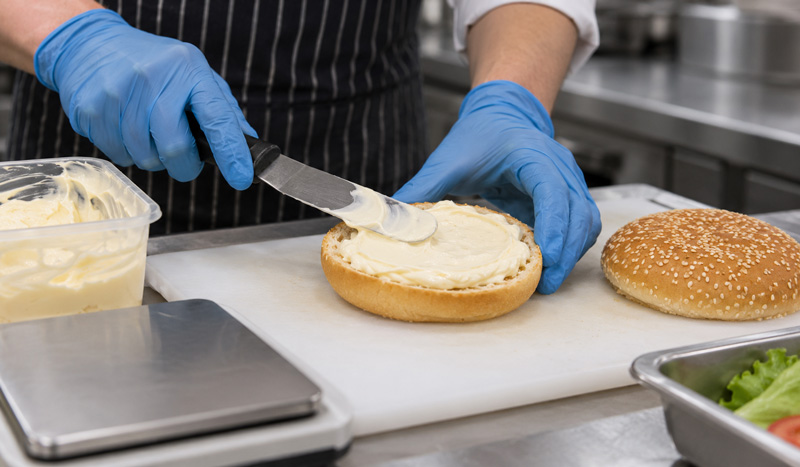
3. Test one: the spread test
Set up. The standard bun, the store's applicator (spatula, squeeze bottle or portion spoon), a scale. Sauce at the temperature it will be used at in the store.
Do. Weigh the set portion onto the bun. Spread with one pass of the tool, or one squeeze, as the store crew would. Close the bun and press lightly as a customer would.
Observe and record. Coverage: to the edge, or short. Passes needed: one, or more. Behaviour on closing: stays, or squeezes out. Surface: even, or streaky. Tool residue: what stays on the spatula or in the nozzle.
Repeat for each candidate with the same portion, and repeat with the reference sauce. A candidate that needs two passes where the reference needs one has told the team something about labour as well as texture.
4. Test two: the coating test
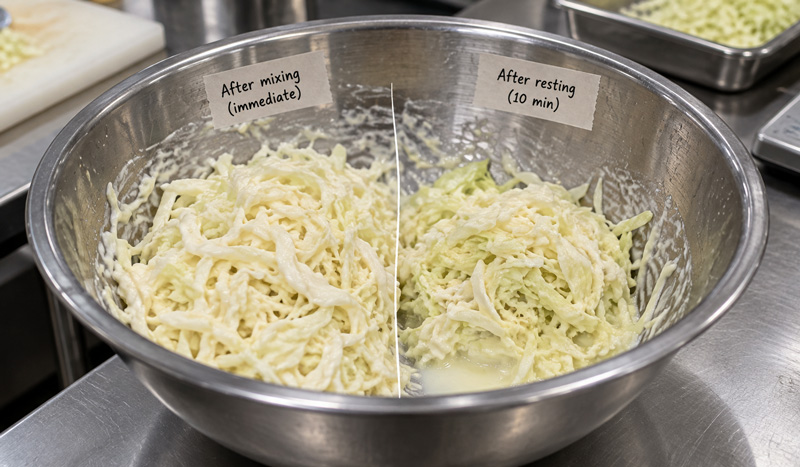
Set up. A fixed weight of the cold ingredient the sauce will be mixed with (shredded cabbage for slaw, cooked diced potato, chopped lettuce for a wrap filling), the set portion of sauce, a bowl and the store's mixing tool.
Do. Add the sauce to the ingredient and mix for a fixed number of turns. Let it stand for the interval the store would hold it before serving, under the approved storage conditions.
Observe and record. Distribution: every piece coated, or bare pieces. Pooling: sauce at the bottom of the bowl, none or some. After standing: still coated, or drained; any free water. Appearance: glossy, or dull and broken.
A mayonnaise that coats well immediately but drains after standing is behaving differently from one that holds; both may have the same viscosity reading.
5. Test three: the hold test
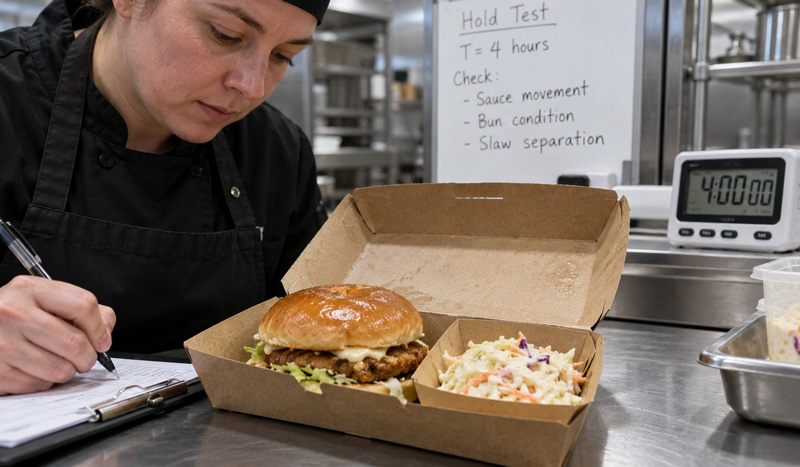
Set up. A finished item from each of the two tests above, in the packaging it would be served or delivered in, under the storage and time conditions the chain's food-safety team has approved for the item.
Do. Hold for the approved interval. Open and look.
Observe and record. On the bun: sauce still in place, or moved; bun surface sodden, or intact. In the slaw: coated, or separated. Any oil or water visible.
The approved interval is set by the food-safety team from the product's storage instructions and the local rules; this test observes texture within that interval and changes nothing about it.
6. The record
Three tests, one page per candidate, and a comparison with the reference in every row. Kept with the sample code, the page is what the team sends to the supplier when something needs to change.
|
Field |
Spread |
Coating |
Hold |
|
Sauce code, batch, pack, temperature |
|
|
|
|
Item or ingredient and weight |
|
|
|
|
Portion (grams) |
|
|
|
|
Tool and passes / turns |
|
|
|
|
Immediate observation |
|
|
|
|
After standing / holding: interval and observation |
|
|
|
|
Compared with reference |
Better / same / worse |
Better / same / worse |
Better / same / worse |
|
Photo |
|
|
|
7. Reading the results
A candidate that spreads to the edge in one pass but pools at the bottom of the slaw bowl is thinner in use than it looks on the bun; the coating test caught what the spread test did not. A candidate that coats well but squeezes out of the closed bun is firmer at rest and thins under pressure. Neither result is a fault in itself; each is a match or a mismatch with a job. A chain that uses one mayonnaise for both jobs is asking for a compromise and should know which way it is compromising.
What the team sends the supplier is the observation and the job, not a diagnosis: “at our portion, on our bun, with our spatula, coverage was short of the edge and needed a second pass; the reference covers in one.” The supplier's development team can work with that.
8. Hongburg's mayonnaise directions
Hongburg's mayonnaise page lists real, lite, egg-free and flavoured directions, and its sandwich and burger mayonnaise page describes the product as creamy, smooth and spreadable, with creaminess, oiliness, viscosity and texture open to adjustment and final specifications confirmed through sample testing.
The specifications put numbers beside those words: viscosity on a Brookfield viscometer with an S64 spindle at 25 °C and 10 rpm of 50,000–80,000 mPa·s for Real Mayonnaise, 12,000–30,000 for Light and 40,000–70,000 for Vegan, each with an emulsion stability test (centrifuged at 25 °C, 3,000 r/min, 30 minutes; no free oil; phase separation not more than 2%) and a texture description of smooth, creamy and spreadable at moderate viscosity, with the Light and Vegan products described as lighter in the mouth.
The three ranges overlap, which is the point of this article: the overlap means the spread and coating tests above, not the viscosity figure, are what separate the three in a given kitchen. The Real product is built on soybean oil and egg yolk at 70–90% fat; the Light and Vegan products on rapeseed oil with modified starch at 20–30% fat each, so their body comes partly from starch and behaves differently under a spatula and in a cold bowl.
9. Frequently asked questions
Is the higher-viscosity product better for coleslaw?
Not necessarily. Coleslaw is judged on whether the sauce drains after standing, which the coating test answers, not on the viscosity reading.
Should the tests be run at more than one temperature?
If the sauce has more than one working temperature in the store — for example taken from the chiller for the morning shift and already at line temperature by the lunch peak — run each test at both. A sauce that is stiff cold is an operations issue, and it is one that can be written into the handling instruction.
How many grams per test?
Use the store's set portion, not a test-only figure. A result obtained at a different portion does not hold in the store.
Can Hongburg supply spread and coating data?
Viscosity, emulsion stability and a texture description sit in our product technical specifications. How a product performs on your bun, at your portion, with your tool comes out of your own bench test.
10. Sending a spread or coating requirement to Hongburg
A chain can send its item, portion, tool and the three-test record for its current product through the Hongburg inquiry page. The discussion can then address which direction (real, lite, egg-free) fits the job and what the sample should be tested against. See our real mayonnaise, lite mayonnaise and vegan mayonnaise pages.
Samples are free; freight is paid by the customer.
Send us your spread or coating requirement → https://hongburg.com/message.html
Sources: Hongburg product technical specifications; Shariful et al., Reviews in Agricultural Science (2018); International Journal of Food Properties (2015).
Send Inquiry
