
- English
- Español
- Português
- русский
- Français
- 日本語
- Deutsch
- tiếng Việt
- Italiano
- Nederlands
- ภาษาไทย
- Polski
- 한국어
- Svenska
- magyar
- Malay
- বাংলা ভাষার
- Dansk
- Suomi
- हिन्दी
- Pilipino
- Türkçe
- Gaeilge
- العربية
- Indonesia
- Norsk
- تمل
- český
- ελληνικά
- український
- Javanese
- فارسی
- தமிழ்
- తెలుగు
- नेपाली
- Burmese
- български
- ລາວ
- Latine
- Қазақша
- Euskal
- Azərbaycan
- Slovenský jazyk
- Македонски
- Lietuvos
- Eesti Keel
- Română
- Slovenski
- मराठी
- Srpski језик

How Should Restaurant Chains Test Sauces for Heated Applications?
How Should Restaurant Chains Test Sauces for Heated Applications?
A cheese sauce that is perfect from the pump at room temperature can break in the bain-marie by the end of a lunch service. A mayonnaise-based sauce that works cold can split the moment it touches a grill plate. A BBQ glaze that holds in the pan can scorch in the oven. Heat changes sauces, each type in its own way, and a chain that puts a sauce into a hot process needs a test that reproduces its own process, not a general assurance.
This article is for development and operations teams designing that test. It explains what heat does to the main sauce types, shows how to define the application precisely enough to test it, and gives a three-stage protocol with a record. Physical stability and food safety are different questions; that distinction is made once, below, and then the article stays on the physical side.
1. What heat does to each sauce type
Emulsified sauces (mayonnaise, burger sauces, garlic and spicy mayonnaises). The egg yolk that holds the oil droplets is heat-sensitive. A study of yolk functionality found that even a mild heat treatment at 68 °C changed droplet size and viscosity, and that longer heating turned the yolk into a gel that would not disperse. (Guilmineau and Kulozik, Journal of Food Engineering, 2007) In use, this is the split: the emulsion lets go and oil pools. Products designed to survive heat replace or reinforce the yolk with other emulsifiers and often with modified starch; they are different formulas, and the label and taste change with them.
Starch-thickened sauces (cheese sauces, many cooking sauces, some ketchups). Native starch thickens when heated and can thin again under prolonged heat, shear or acid, and it retrogrades on cooling, which pushes out water. Cross-linked modified starches are chosen specifically to resist heat, shear and acid, and pregelatinized starches thicken without heating. A cheese sauce's behaviour over four hours in a warmer is largely a question of which starch system it uses.
Sugar-rich sauces (BBQ, honey mustard, sweet chili). Sugar caramelizes and then burns. The failure is scorching and darkening at contact surfaces, and thickening as water is driven off.
Tomato-based sauces. Generally tolerant of heating; the risks are darkening, drying at the edge of a pan, and separation where starch or gum is present.
The type tells the team what to look for. It does not tell them whether a specific product will pass in their process.
2. Define the application before testing
"Heated application" is not a test condition. The following is.
|
Element |
Example entries |
|
Product and pack |
Sauce code, batch, pack format |
|
Equipment |
Bain-marie, warmer, pump warmer, grill plate, oven, microwave, fryer |
|
Temperature |
Set point and how it is checked |
|
Time |
Total time in heat; time in contact with the item |
|
Contact |
Direct on hot protein; on a hot item after cooking; in a warmer then dispensed; baked inside a product |
|
Agitation |
Stirred, pumped, static |
|
Cycles |
Heated once; reheated; held then cooled then reheated |
|
Amount |
Full pan or a portion |
A chain filling this in will usually find that it runs the same sauce through two or three different heat exposures across its menu. Each one is a separate test.
3. The three-stage protocol
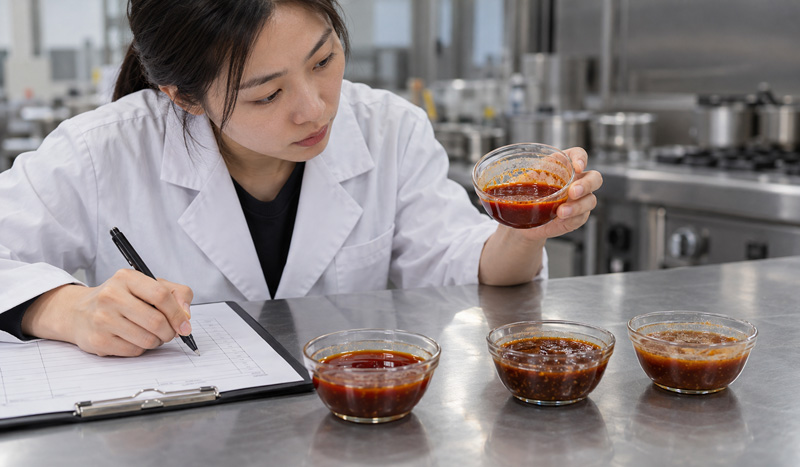
Stage one: bench. Small quantity, the defined temperature and time, on a hot plate or in a water bath with a thermometer. Purpose: to see whether the product survives the heat at all. Observe at fixed intervals.
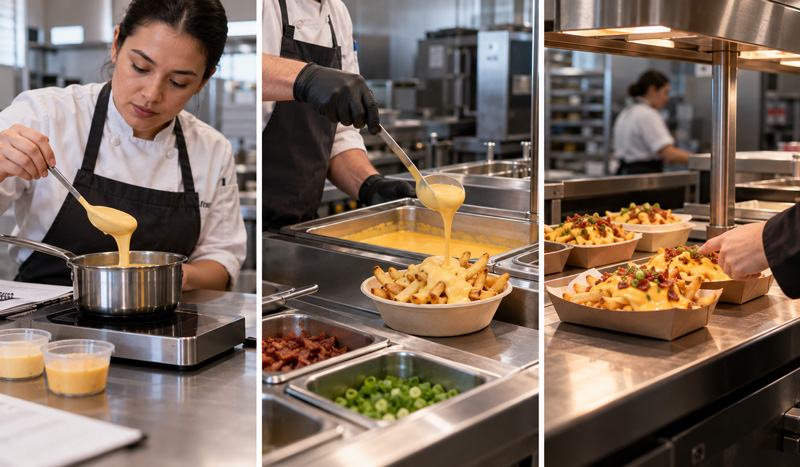
Stage two: line. The actual equipment in a test kitchen, the actual amount, the actual contact with the item, for the full service interval. Purpose: to see how the product behaves in the process, including pumping, stirring, and the addition of cold product to hot.
Stage three: hold. The finished item, held or delivered as it would be to the customer, opened and assessed at the approved interval. Purpose: to see what the customer sees.
Each stage uses the same observation list and the same reference: the product at room temperature from the pack.
4. What to observe
Each observation is recorded as present or absent at each interval, with a photo, and compared with the reference.
|
Observation |
|
What it looks like |
|
Which sauces show it |
|
|
Oil-out |
|
Clear oil pooling at the surface or edge |
|
Emulsified sauces |
|
|
Thinning |
|
Runs where it held shape before |
|
Starch sauces under long heat or acid; emulsions starting to break |
|
|
Thickening or drying |
|
Skin on the surface, crust at the pan edge, drag on the pump |
|
Starch and sugar sauces; any sauce with water driven off |
|
|
Skin |
|
Film on a standing surface |
|
Starch and cheese sauces |
|
|
Scorching |
|
Darkening and burnt notes at contact surfaces |
|
Sugar-rich sauces |
|
|
Colour shift |
|
Darker, duller, or browner than the reference |
|
Tomato and sugar sauces; cheese sauces |
|
|
Graininess |
|
Loss of smoothness, specks |
|
Cheese and emulsified sauces |
|
|
Water separation |
|
Free water after cooling or on the held item |
|
Starch sauces |
|
|
Flavour change |
|
Cooked, flat, burnt or acidic notes |
|
All |
|
|
Field |
Stage 1 bench |
|
Stage 2 line |
|
Stage 3 hold |
|
Product, batch, pack |
|
|
|
|
|
|
Equipment and set point |
|
|
|
|
|
|
Time in heat / intervals observed |
|
|
|
|
|
|
Contact and agitation |
|
|
|
|
|
|
Oil-out / thinning / thickening / skin |
|
|
|
|
|
|
Scorching / colour / graininess / water |
|
|
|
|
|
|
Flavour vs reference |
|
|
|
|
|
|
Pump or dispense behaviour (if used) |
|
|
|
|
|
|
Result: pass for this application / adjust / fail |
|
|
|
|
|
|
Photos |
|
|
|
|
|
5. Safety is the other question
Everything above is about texture and appearance. Whether a sauce may be held hot for a given time, at what temperature, and for how many reheat cycles, is a food-safety question that the chain's food-safety team answers from the product's storage instructions and the local rules. Codex's General Principles of Food Hygiene ask for time and temperature controls that are validated for the product and its intended use. A sauce that stays smooth for six hours in a warmer has passed a texture test. Nothing else follows from that.
6. Reading the results
A cheese sauce that thickens and skins in the warmer but is fine when stirred every twenty minutes has given the team an operating instruction, not a rejection. A burger sauce that oils out on the grill plate but holds when applied to the patty after cooking has given the team an assembly-order instruction. A BBQ glaze that scorches in the oven at the set temperature but holds when applied in the last minutes has given the team a process change. Most "failures" in stage one become procedures by stage two; the ones that remain are the product's limits, and those go to the supplier with the record.
7. Hongburg's hot-application products
Hongburg's cheese sauce page describes products for cooking, baking, topping and dipping, with thickness, viscosity and smoothness among the attributes that can be discussed, and its BBQ sauce page lists grilling, glazing and marinating as applications. Those pages indicate which products are positioned for heat. The specifications say what they are made of.
The cheddar cheese sauce is a water-and-soybean-oil emulsion with yellow cheddar, whey and milk protein, thickened with hydroxypropyl distarch phosphate and xanthan gum and emulsified with polyglycerol fatty acid esters and lecithin, at pH 5.4–6.2, 5–10% fat and 8,000–22,000 mPa·s viscosity on a Brookfield viscometer with an S64 spindle at 25 °C and 10 rpm. The cream cheese sauce is built the same way on soybean oil at pH 5.2–6.0 and 15–20% fat. The BBQ sauce is a sugar-rich, vinegar-acidified tomato sauce (20–26°Brix, pH 3.6–4.2, Bostwick 3–6 cm/30 s) thickened with acetylated distarch phosphate and coloured with caramel, which is the profile that scorches at contact surfaces if left on direct heat.
Hongburg's mayonnaise products are egg-yolk emulsions (Real) or egg-yolk and starch emulsions (Light), with the Vegan product relying on polyglycerol esters and starch; none is specified as heat-stable, and a chain planning to grill or bake with them runs stage one before anything else. How a given product behaves in a chain's specific process is what the protocol above finds out.
8. FAQ
Can Hongburg simply tell us which sauce is heat-stable?
Our product pages state which applications each product is positioned for, and the cheese sauces and BBQ sauce are positioned for heated use. But "heat-stable" is not a one-line answer: it depends on your temperature, time, contact and agitation. Stage one is how that question gets answered for your conditions.
If stage one fails, is the product unusable?
Usually not. It often means the process changes — a different assembly order, a different point at which the glaze goes on, or a stirring step. Only a failure that survives those changes is a product limit.
If stirring in the warmer fixes it, do we still need to test?
Yes, and the test becomes the instruction: how often to stir, and how thoroughly. That is exactly what stage two is for.
How do we set the safe holding time?
Your food-safety team sets it from the product's storage instructions and the local rules. The tests in this article observe texture only and do not set a holding limit.
9. Sending a heat-application question to Hongburg
A chain can send its application definition, with the table above filled in for its own equipment and menu, through the Hongburg inquiry page. The reply can then address which product direction fits the process and how the sample should be tested. See our cheese sauces, BBQ sauce, pizza sauce and cooking sauces pages.
Samples are free; freight is paid by the customer.
Send us your heat-application conditions → https://hongburg.com/message.html
Send Inquiry
