
- English
- Español
- Português
- русский
- Français
- 日本語
- Deutsch
- tiếng Việt
- Italiano
- Nederlands
- ภาษาไทย
- Polski
- 한국어
- Svenska
- magyar
- Malay
- বাংলা ভাষার
- Dansk
- Suomi
- हिन्दी
- Pilipino
- Türkçe
- Gaeilge
- العربية
- Indonesia
- Norsk
- تمل
- český
- ελληνικά
- український
- Javanese
- فارسی
- தமிழ்
- తెలుగు
- नेपाली
- Burmese
- български
- ລາວ
- Latine
- Қазақша
- Euskal
- Azərbaycan
- Slovenský jazyk
- Македонски
- Lietuvos
- Eesti Keel
- Română
- Slovenski
- मराठी
- Srpski језик

How Should Restaurant Chains Select and Test Sauces for Menu Applications?
How Should Restaurant Chains Select and Test Sauces for Menu Applications?
1. Start with the job the sauce has to do
A sauce chosen for a dine-in signature burger is not automatically the right one for a delivery wrap. Three things go into the brief before any product is shortlisted: the country, the menu item, and whether the item is eaten in store or delivered.
A note on sources. Where this article gives a Hongburg figure, it comes from our product technical specifications. The rules that decide what a product may be called, what may go into it and how it must be labelled are those of your destination country, and they are checked for each project.
2. Which sauce family fits which job
The table below is for the chain's menu team. The right-hand column is what your staff should watch for during a trial, not what we promise.
|
Job on the menu |
What the sauce has to do |
What follows for the buyer |
|
Signature flavour |
Give the item its identity; usually the only sauce on it |
Flavour and colour are judged on the assembled item, not from a spoon |
|
Background layer |
Add moisture and richness without competing with the filling |
Spread and portion control matter more than flavour intensity |
|
Topping |
Sit visibly on the item, often warm |
Texture during the service interval and behaviour on hot ingredients |
|
Dip |
Served separately, often in a portion cup or sachet |
Portion pack, cost per serving and takeaway handling |
Two rules of thumb follow from this. A signature sauce is judged on the item with nothing else added. A background layer is judged on how reliably staff can apply it. A variant such as garlic mayonnaise is still mayonnaise for handling purposes: the pack, the dispenser and the portion behave the same way, and only the flavour decision changes.
|
Family |
Typical job |
What to observe on the assembled item |
|
Mayonnaise |
Background layer, mixing base, or a flavoured variant as the signature |
Whether the set portion spreads to the bun edge with your applicator; whether it stays put when the bun is closed and pressed; for garlic or spicy variants, whether the flavour is still clear next to the filling |
|
Burger sauce |
Signature flavour |
Whether the item tastes distinct with this sauce alone; colour against the patty and bun; whether it thins or runs after contact with the hot patty |
|
Cheese sauce |
Topping, hot or cold |
Texture after sitting for the service interval; whether it coats or slides off; behaviour under your actual heating or holding method |
|
Signature flavour or glaze |
Sweetness against the patty's own seasoning; how far it soaks into the bun during the service interval; colour on the item |
|
|
Accent |
Whether the sharpness is noticeable at the set portion without dominating; line control from the dispenser |
3. The kitchen side: pack, dispenser and the numbers behind them
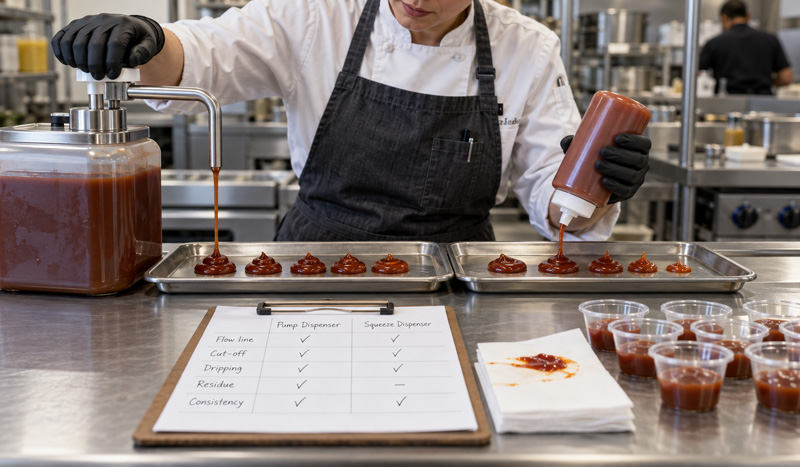
A bucket does not make a sauce pump-ready. If a pump is planned, test the pump and the sauce together.
For the mayonnaise layer, the Real Mayonnaise specification gives your team a starting point: fat 70–90%, pH not more than 4.2, salt 1.7–3.1%, viscosity 50,000–80,000 mPa·s measured on a Brookfield viscometer with an S64 spindle at 25 °C and 10 rpm, emulsion stability tested by centrifuging at 25 °C and 3,000 r/min for 30 minutes with no free oil and a phase separation rate of not more than 2%, egg and soybean as allergens, and 12–24 months shelf life by pack with refrigeration after opening.
Note the distinction: 70–90% is what our product is specified to contain. Some markets set a legal minimum — the United States, for example, requires not less than 65% vegetable oil for a product to be called mayonnaise. A legal floor and a product specification are two different numbers, and a comparison sheet that mixes them will mislead whoever reads it.
The cheddar cheese sauce is specified at pH 5.4–6.2, fat 5–10%, and viscosity 8,000–22,000 mPa·s on the same Brookfield basis, thickened with hydroxypropyl distarch phosphate and xanthan gum, with milk and soybean as allergens. How it behaves under a given store's heat is found in that store's own test, not in the specification.
Pack formats and net weights are confirmed per project and per product. Our packaging reference lists the families we work with — sachets from 10 g, pouches from 250 g, squeeze and plastic bottles, plastic buckets at 1.5/3/3.75 kg for foodservice, and cans. A family being available does not mean every sauce is offered in every format, so the sauce-and-pack pair is confirmed for the specific sauce before a trial is planned.
4. A menu trial you can run in a week
The plan below is a hypothetical example, not a customer record. The task: shortlist a garlic or spicy mayonnaise for a proposed chicken burger.
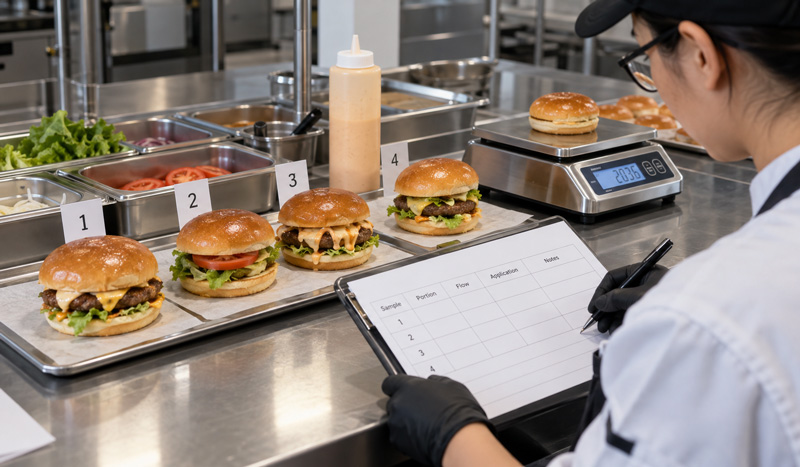
Everything except the sauce stays fixed — the same bun, the same fillet preparation, the same lettuce and pickle, the same placement, the same applicator and the same assembly order. Your team sets and records its own portion and its approved handling conditions before the first burger is made. This example assigns no grams, temperatures, times or scores, because those are yours to set.
Blind codes and consistent presentation reduce bias in the tasting step. Record the operations observations separately from the tasting, so that a sauce which tastes right but dispenses badly is sent back for adjustment rather than approved on flavour alone.
|
Stage |
What stays fixed |
What the team learns |
|
Side-by-side |
Everything, including the portion |
Which candidate fits the menu brief under identical conditions |
|
Adjustment |
The menu item and the safety controls; portion, placement or tool may change, and each change is written down |
Whether a candidate reaches the target with a workable portion and method |
|
Store repeat |
The chosen version and its written instructions |
Whether a store crew gets the same result |
5. What the trial record should capture
Everything below is measured in the trial. None of it is a pre-filled result.
· Setup — sauce code and batch, pack, menu item, store or test kitchen, tool, assembly order, the handling instructions in force
· Portion — grams dispensed on each of a run of consecutive portions, and the spread between the highest and lowest
· Flow — whether the line holds, how it cuts off, dripping, residue on nozzle or walls, what is left in the pack at the end
· On the item — spread or coating, bun softening, sauce sliding, water separation, any change after contact with the hot filling
· Service format — dine-in against takeaway or delivery packaging, with the evaluation time and packaging noted
· Work — transfers, refills and cleaning steps added by this pack and tool
One prerequisite sits outside the tasting. Obtain allergen information for the exact sample before anyone tastes it. Follow the supplier's storage and after-opening instructions. Have your food-safety team approve the handling conditions used in the trial. A good tasting result changes nothing about shelf life or holding limits.
6. Cost per portion, kept simple
The price per kilogram is the starting point. The figure the buyer actually compares is the sauce cost of one served portion, and it comes from the trial run:
Sauce cost per portion = (sauce used in the run × cost per gram) ÷ portions made in the run
Sauce used is the pack weight at the start minus what is still usable at the end. It therefore already includes over-dispensing, what stayed in the pack and what was lost in transfer, so no separate waste percentage is added on top. Portions made means every portion the sauce went onto, whether or not a bun or a patty later failed inspection — the sauce should not carry the cost of another ingredient's fault.
Two lines complete the comparison without turning it into a full costing exercise: the time per portion the crew needed with this pack and tool, and any extra cleaning or transfer steps. Calculate dine-in and delivery separately when their portions or packaging differ.
7. When head office and a store disagree
Before anyone asks for a reformulation, put the two records side by side. If the records match and the difference remains, send the observation to the supplier with the sample code and the conditions attached. The trial evidence will point to the fix: the product, the pack and tool, or the store instruction.
8. Frequently asked questions
Does a higher viscosity number mean a thicker sauce on the bun?
Not on its own. A viscosity reading only compares within the same method, spindle, speed and temperature. Ask for those three conditions with every number you are given.
Can we use a bucket sauce in a squeeze-line setup?
Only after testing the sauce and the pump or dispenser together. Pack size does not tell you whether the product will hold a clean line.
Is a garlic mayonnaise a different product to handle?
For pack, dispenser and portion, no. Only the flavour decision changes.
Can Hongburg tell us which pack our stores should use?
We can tell you which formats we work with. Which one suits your stores depends on your dispenser, your service interval and your portion — that comes out of your trial.
9. Talking to Hongburg about a menu
A menu inquiry works best with the sauce's job, the country, the candidate family, the reference sauce if there is one, the pack and tool in use, and the operating or cost question to settle. Our sandwich and burger mayonnaise page lists acidity, saltiness, creaminess, oiliness, viscosity, colour and texture as the points that can be discussed — a practical way to narrow a shortlist before your own trial. See also our real mayonnaise, cheese sauces, BBQ sauce and mustard pages.
Samples are free; freight is paid by the customer.
Planning a menu sauce trial? Tell us the sauce role, market, menu item, pack format and application question you want to solve. Contact Hongburg → https://hongburg.com/message.html
Sources: Hongburg product technical specifications; University of Nottingham, Getting Started With Sensory Evaluation (2018); Codex Alimentarius CXC 1-1969 (revised 2022, Sections 5 and 13); Codex Alimentarius CXC 80-2020 (Sections 5.2–5.3).
Send Inquiry
