
- English
- Español
- Português
- русский
- Français
- 日本語
- Deutsch
- tiếng Việt
- Italiano
- Nederlands
- ภาษาไทย
- Polski
- 한국어
- Svenska
- magyar
- Malay
- বাংলা ভাষার
- Dansk
- Suomi
- हिन्दी
- Pilipino
- Türkçe
- Gaeilge
- العربية
- Indonesia
- Norsk
- تمل
- český
- ελληνικά
- український
- Javanese
- فارسی
- தமிழ்
- తెలుగు
- नेपाली
- Burmese
- български
- ລາວ
- Latine
- Қазақша
- Euskal
- Azərbaycan
- Slovenský jazyk
- Македонски
- Lietuvos
- Eesti Keel
- Română
- Slovenski
- मराठी
- Srpski језик

How Should Restaurant Chains Balance Sweet, Sour and Salty Flavours in Sauces?
How Should Restaurant Chains Balance Sweet, Sour and Salty Flavours in Sauces?
A sauce that tastes right from a spoon can taste wrong on the fries. This is not a formulation failure; it is how taste works. The three basic tastes that dominate most menu sauces — sweet, sour and salty — change one another, and the food the sauce is eaten with adds its own sweet, sour and salt to the mix.
This article is for the people in a chain who approve a sauce's flavour: the development lead, the operations manager who has to make it work in fifty kitchens, and the buyer who has to describe the target to a supplier. It explains the interaction, shows how to taste in a way that reflects the menu, and gives a way to write a flavour target a supplier can act on.
1. The tastes interfere with each other
In a controlled study using water solutions of sugar, salt, citric acid and a bitter compound, alone and in every combination, sweetness turned out to be both the least suppressed taste and the strongest suppressor of the others; in one two-way mixture, sugar reduced perceived saltiness by more than 80%. The authors caution that results in water cannot be assumed to transfer directly to real foods, where texture, aroma and temperature also play. (Green et al., Physiology & Behavior, 2010)
The lesson for a menu team is directional, not numerical. Raising sweetness in a sauce will tend to soften both its sharpness and its saltiness; cutting salt will let sweetness and sourness show more. A request to change one taste is a request to rebalance three.
2. The food changes the sauce
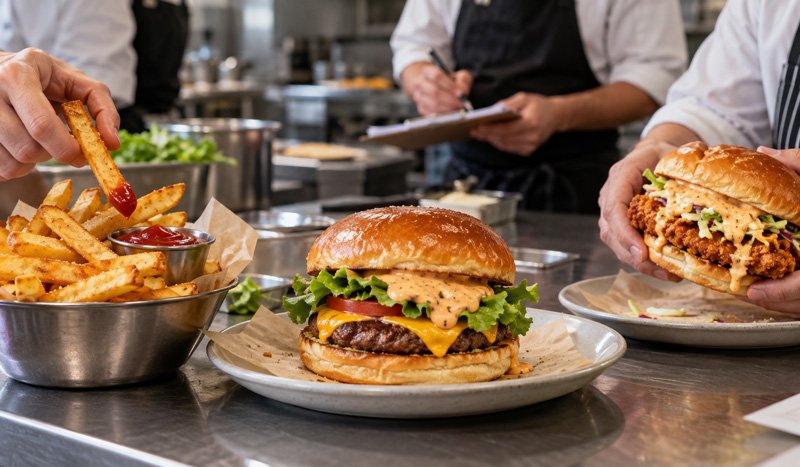
Every menu item brings its own tastes to the mouthful. A fry carries salt and fat. A brioche bun carries sugar. Pickles bring acid and salt. A grilled patty brings salt and savoury depth; a breaded chicken fillet brings salt and a neutral crumb. The sauce is tasted against all of that, in the proportion the portion sets.
|
Menu context |
What the item adds |
What tends to happen to the sauce |
What the team usually adjusts |
|
Salted fries with ketchup |
Salt, fat |
Sauce reads sweeter and less salty; acidity welcome |
Acidity up or sweetness down, not salt |
|
Brioche bun burger with burger sauce |
Sugar in the bun |
Sauce reads less sweet; sharpness stands out |
Sweetness or creaminess up; acidity checked |
|
Fried chicken sandwich with spicy mayonnaise |
Salt, fat, heat from the coating |
Heat compounds; salt stacks |
Salt down in the sauce; heat set against the coating |
|
Pickled or slaw-topped item |
Acid, salt |
Sauce acidity reads sharp |
Acidity down; sweetness checked |
|
Grilled meat with BBQ sauce |
Salt, char, savoury depth |
Sweet-smoky sauce can read cloying if the meat is lightly seasoned |
Balance set on the actual seasoning level |
The direction and the size of any change are decided by tasting the actual item.
3. Taste it twice: alone, then together
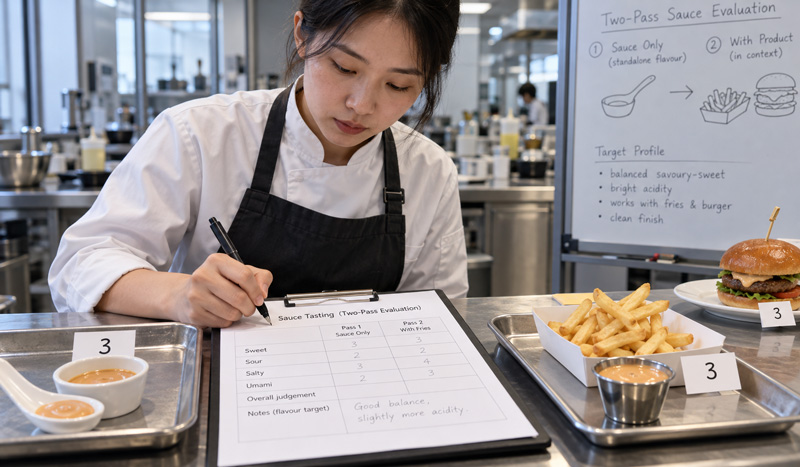
The most common error in sauce approval is tasting once, from a spoon, in a meeting room. A method that reflects the menu has two passes and a written comparison.
Pass one: the sauce alone. Room temperature or the serving temperature, a coded cup, a neutral cracker or water between samples. Each taster writes a one-word note for sweetness, sourness and salt: low, medium or high against the reference.
Pass two: on the item. The standard build, made by one person to the written procedure, with the sauce at the set portion. Same tasters, same coded samples, same three notes, plus one more: overall, does the item taste as intended?
Blind codes and consistent presentation reduce bias in both passes.
The gap between the "alone" and "on item" columns is the information. A candidate that scores medium sweet alone and low sweet on a brioche bun has told the team exactly what the bun is doing.
4. Portion is a flavour variable
Doubling the sauce portion does not double the flavour; it changes the balance between sauce and item. A sauce set for a small portion may taste heavy when a store over-dispenses, and a store crew that finds a sauce sharp may respond by using less, which changes the item in a different way. Flavour approval therefore happens at the written portion, and the portion is part of the flavour target sent to the supplier.
5. A worked example, hypothetical
A chain is choosing a ketchup for its fries. From the spoon, Candidate A is the panel's favourite: rounder, sweeter, less sharp than the current product. On the fries, built with the standard salt level, Candidate A reads flat and sugary while the current product's sharper acidity cuts the fat and salt. The team writes down what it learned: for this fry, the acidity is doing the work, and the sweetness the panel liked from the spoon is being covered by the fry's salt.
The flavour target that goes to the supplier is then specific: keep the current acidity level on the fries, round the sweetness slightly, hold salt. A sample comes back, is tasted the same two ways, and the record shows whether the gap closed.
This example carries no grams, no acid values and no scores; those come from the chain's own tasting.
6. Writing a flavour target a supplier can act on
A supplier can work from a target that names the reference, the item, the portion and the direction of change for each of the three tastes. A target written as "more balanced" or "less artificial" cannot be actioned.
Hongburg's product pages list sweetness, acidity and saltiness among the attributes that can be adjusted for ketchup, burger sauce and mayonnaise. The specifications show where the three tastes start: ketchup at 20–24°Brix, pH 3.4–4.0 and 2.5–3.8% salt; Real Mayonnaise at pH not more than 4.2 and 1.7–3.1% salt; BBQ sauce at 20–26°Brix, pH 3.6–4.2 and 2.0–2.5% salt; yellow mustard at pH 3.2–3.8 and 2.5–3.8% salt. A target that says "same acidity as the current ketchup, slightly sweeter on the fries" is asking to hold one range and move another, and that is a task a development team can act on.
|
Element |
Example wording |
|
Reference |
Current listed ketchup, batch retained by both sides |
|
Item and portion |
Standard fries at the written salt level; sauce at the written portion |
|
Sweetness |
Slightly higher than reference when tasted on the fries |
|
Sourness |
Same as reference on the fries |
|
Salt |
Same as reference |
|
Other |
Tomato flavour no weaker than reference |
|
Judged by |
Panel of eight, two-pass method, blind |
7. Where flavour requests usually fall short
The gaps suppliers see most often are a target described from a spoon tasting only, no reference sample, no portion, and a request that names one taste when the panel's real reaction was to the balance.
8. Frequently asked questions
Can flavour be approved from a spoon?
Not on its own. A spoon tasting screens out clearly unsuitable candidates, but approval happens on the actual item at the actual portion.
Can a supplier change salt only and leave everything else?
It can be asked for, but the three tastes are linked. Cutting salt lets sweetness and sourness show more, and one of them usually needs a small adjustment at the same time.
What if the panel disagrees internally?
Go back to the two-pass method and have each person write down both the spoon and the on-item judgement. The disagreement is usually between someone who only tasted the spoon and someone who only tasted the item.
How does Hongburg handle a flavour adjustment?
Sweetness, acidity, saltiness, creaminess, oiliness, viscosity, colour and texture can all be discussed; final specifications are confirmed through sample testing and project discussion.
9. Sending a flavour target to Hongburg
A chain can send its reference, the menu item and portion, and the two-pass tasting record through the Hongburg inquiry page. The discussion can then focus on which direction to move each of the three tastes and how the next sample will be judged. See our tomato ketchup, burger sauce, mayonnaise, BBQ sauce and mustard pages.
Samples are free; freight is paid by the customer.
Send us your flavour target → https://hongburg.com/message.html
Send Inquiry
