
- English
- Español
- Português
- русский
- Français
- 日本語
- Deutsch
- tiếng Việt
- Italiano
- Nederlands
- ภาษาไทย
- Polski
- 한국어
- Svenska
- magyar
- Malay
- বাংলা ভাষার
- Dansk
- Suomi
- हिन्दी
- Pilipino
- Türkçe
- Gaeilge
- العربية
- Indonesia
- Norsk
- تمل
- český
- ελληνικά
- український
- Javanese
- فارسی
- தமிழ்
- తెలుగు
- नेपाली
- Burmese
- български
- ລາວ
- Latine
- Қазақша
- Euskal
- Azərbaycan
- Slovenský jazyk
- Македонски
- Lietuvos
- Eesti Keel
- Română
- Slovenski
- मराठी
- Srpski језик

Kraft Heinz and Disney Alliance Signals a New Direction for the Sauce Industry
Kraft Heinz and Disney Alliance Signals a New Direction for the Sauce IndustryNews
Date: July 21, 2026
The Kraft Heinz Company and The Walt Disney Company announced a long-term, multi-year strategic alliance on July 21, 2026. The cooperation brings together foodservice, media, events and consumer experiences across Disney destinations and platforms.
Although the announcement concerns two major international companies, it also provides useful signals for sauce importers, distributors, foodservice buyers and private label brands. The development shows how sauces and condiments can move beyond their traditional role as basic food accompaniments and become part of a broader dining, branding and customer-experience strategy.
A Multi-Channel Food and Entertainment Partnership
According to the official announcements, the alliance will extend across Disney’s North American parks and resorts, Disney Cruise Line, studios and streaming platforms.
Ten Kraft Heinz brands—including HEINZ, Philadelphia and Kraft Mac & Cheese—will participate in the collaboration. The companies plan to introduce new menu items, dining experiences and product offerings at hundreds of locations across Walt Disney World Resort, Disneyland Resort and Disney Cruise Line sailings departing from North America.
The cooperation will also include new HEINZ condiment stations and specially designed equipment at Disney parks. Additional sauce-related activities are planned for D23: The Ultimate Disney Fan Event in Anaheim on August 14–16, 2026. The alliance officially launches during the summer of 2026, with activities expected to roll out throughout the year.
For the sauce industry, this is more than a conventional sponsorship or product-placement agreement. It demonstrates how food products can be integrated into restaurant operations, themed environments, digital content and branded consumer experiences.
Foodservice Is Becoming a Product-Discovery Channel
Sauce products have traditionally been divided into two broad channels.
Retail sauces are usually developed for supermarket shelves, household use and branded consumer packaging. Foodservice sauces are more commonly designed around application performance, operational efficiency and larger packaging formats.
The Kraft Heinz–Disney alliance illustrates how these channels can become more closely connected. Consumers may first experience a sauce in a theme park, restaurant, hotel or cruise setting before encountering related products or campaigns through retail and media channels.
For global buyers, this creates several practical questions:
· Will the sauce perform consistently in a commercial kitchen?
· Can the product concept be adapted for retail distribution?
· Are suitable packaging formats available for both channels?
· Can the supplier maintain a consistent flavor profile across different production and packaging requirements?
Importers and distributors may therefore need to evaluate sauce products as part of a wider channel strategy rather than treating retail and foodservice sourcing as completely separate activities.
Sauces Are Becoming Part of the Customer Experience
The announced partnership connects food products with entertainment, themed dining and storytelling-led experiences.
This reflects a broader opportunity for sauce buyers. A sauce can contribute to:
· A recognizable menu item
· A distinctive flavor experience
· A seasonal or promotional product
· A themed foodservice concept
· A connection between restaurant and retail channels
Most sauce buyers will not require entertainment licensing or a partnership of this scale. However, the underlying principle remains relevant: sauces can help businesses create more distinctive products and dining experiences.
Distributors may use differentiated sauces to strengthen their portfolios. Restaurant operators may develop signature menu items. Retail and private label buyers may introduce market-specific flavor concepts supported by appropriate packaging and branding.
The supplier’s role is therefore expanding from basic production toward product development, application support and project coordination.
Product Development May Need to Move Faster
Products associated with events, seasonal campaigns or marketing programs usually have defined launch schedules.
A sauce project may require several activities to be coordinated at the same time:
· Formula development
· Sample preparation
· Application testing
· Packaging selection
· Label confirmation
· Production scheduling
· Export documentation
· Shipment planning
For private label buyers, formulation flexibility can also be important. Different markets may require adjustments to sweetness, salt, acidity, flavor intensity, texture or viscosity.
Hongburg’s product knowledge framework identifies these factors as common customization considerations across products such as mayonnaise, cheese sauce, tomato-based sauces, BBQ sauce and dressings.
When evaluating a potential OEM sauce manufacturer, buyers should consider not only whether the factory can produce a standard product, but also whether its teams can communicate efficiently throughout product development and commercialization.
Packaging Must Match the Sales Channel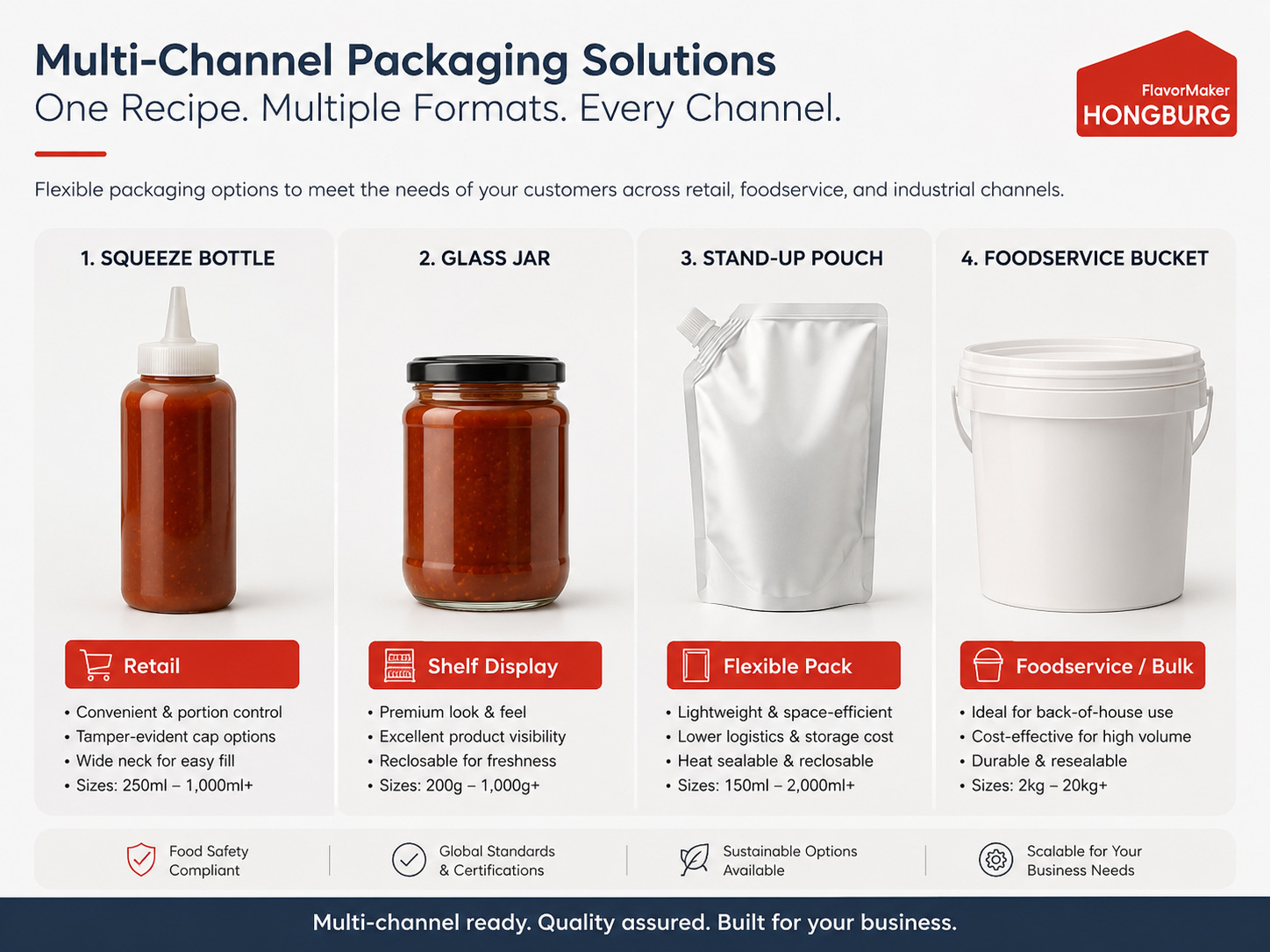
Packaging is a major consideration when the same sauce concept is intended for multiple channels.
Foodservice operators may prioritize:
· Large pouches or buckets
· Efficient dispensing
· Reduced handling time
· Practical storage
· Consistent portion control
Retail buyers may focus more on:
· Squeeze bottles
· Glass bottles or jars
· Sachets and small pouches
· Shelf presentation
· Label and branding requirements
A product developed for foodservice may not automatically be suitable for retail without further evaluation. Filling format, viscosity, dispensing performance, portion size and consumer usage all need to be considered.
Hongburg’s documented packaging capabilities cover five principal families: pouches, aseptic cartons, glass packaging, metal cans and plastic packaging. Available formats include sachets, stand-up pouches, spout pouches, bottles, jars and buckets.
For buyers planning to introduce products across different channels, discussing formula and packaging requirements together can help reduce unnecessary redevelopment.
What This News Means for Global Sauce Buyers
The alliance provides several practical sourcing lessons for importers, distributors, foodservice companies and private label brands.
1. Evaluate Application Performance
A sauce should be assessed according to how it will be used.
Mayonnaise buyers may focus on texture and emulsion stability. Cheese sauce buyers may require reliable performance during heating. BBQ and burger sauce buyers may prioritize viscosity, coating and flavor consistency. Dressing buyers need products that perform predictably in salads, sandwiches and wraps.
Samples should therefore be evaluated in realistic applications rather than through taste testing alone.
2. Plan Foodservice and Retail Products Together
A product concept may begin in foodservice and later move into retail, or begin in retail before being adapted for restaurants and catering.
Planning the product specifications and packaging architecture early can make future channel expansion more efficient.
3. Build Flexibility into Private Label Development
Local flavor preferences and commercial requirements vary between markets.
A private label sauce supplier should be able to discuss:
· Flavor adjustment
· Sweetness and salt levels
· Acidity
· Texture and viscosity
· Packaging formats
· Label coordination
Buyers should confirm which elements can be customized before approving the development process.
4. Review Project-Coordination Capabilities
Time-sensitive launches require coordination among purchasing, product development, packaging, production and logistics teams.
Buyers should examine how a potential supplier manages:
· Product specifications
· Sample approval
· Packaging confirmation
· Production schedules
· Export documents
· Shipment communication
Clear communication is particularly important when several products or packaging formats are being developed simultaneously.
What Buyers Should Look for in a Sauce Supplier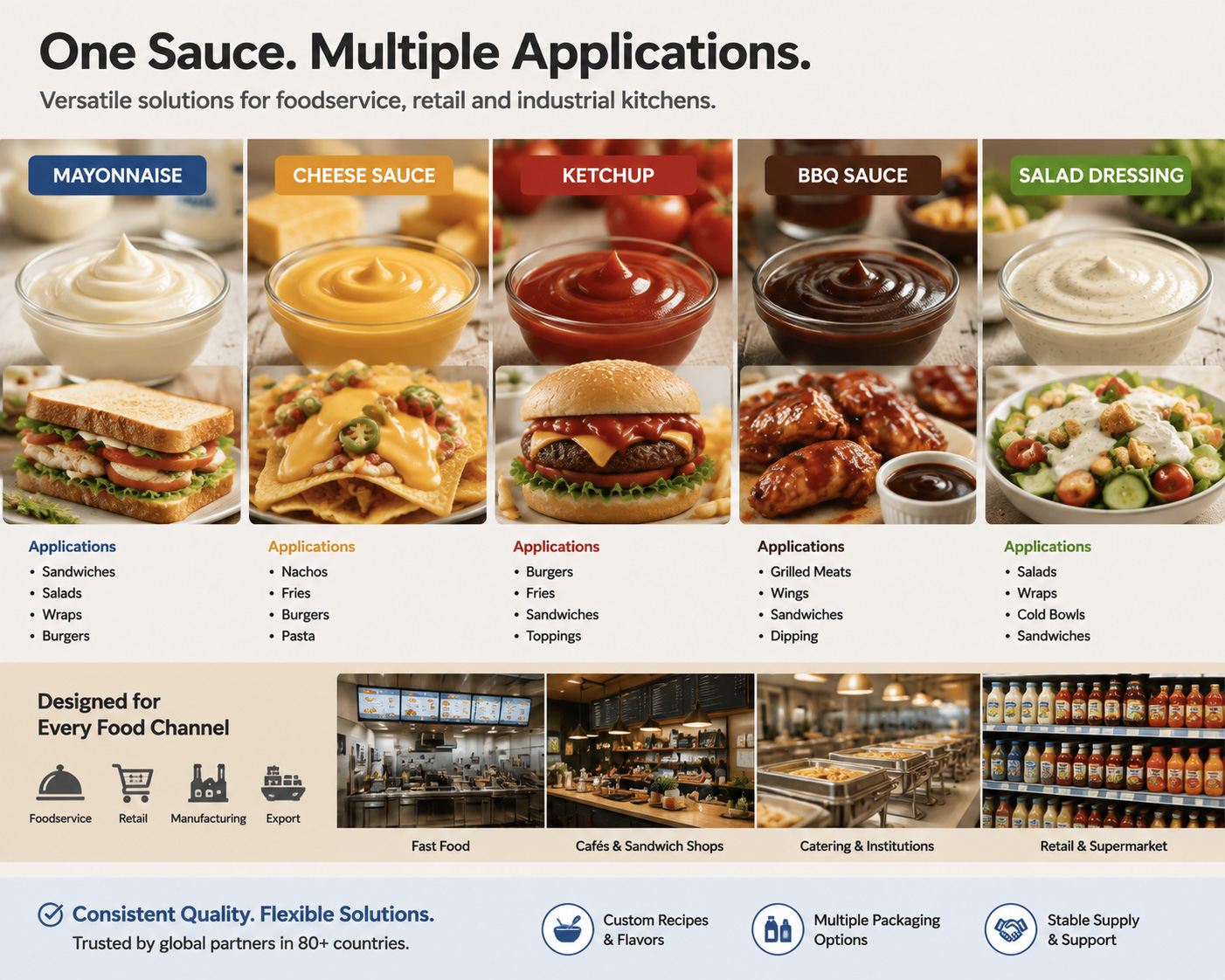
The latest development reinforces the importance of evaluating a supplier beyond basic product price.
International buyers should consider the following areas.
Product Range
A diversified portfolio can help distributors and importers develop coordinated sauce categories.
Relevant product options may include:
· Tomato ketchup
· Tomato sauce
· Pizza sauce
· Pasta sauce
· BBQ sauce
· Burger sauce
· Mustard sauce
· Salad dressings
Customization Support
Market-specific and private label projects may require formula adjustments, application testing and packaging coordination.
Packaging Options
A supplier should be able to discuss packaging according to the intended retail, foodservice or industrial application.
Quality Consistency
Buyers should evaluate whether the supplier has systems for raw-material control, production monitoring, finished-product inspection and documentation management.
Export Support
International projects may require label coordination, production scheduling, export documents and shipment communication.
Hongburg’s Perspective
Hongburg Flavormaker is not involved in the Kraft Heinz–Disney alliance. This article provides an independent B2B interpretation of the publicly announced industry development.
Hongburg Flavormaker is an export-focused food manufacturer specializing in sauces, condiments, tomato-based products and selected canned food products. Its business models include OEM manufacturing, private label production, bulk supply and customized sauce solutions.
Hongburg’s sauce portfolio includes mayonnaise, cheese sauce, tomato-based sauces, pizza sauce, pasta sauce, BBQ sauce, burger sauce, mustard sauce, salad dressings and custard sauce. The company can discuss formula adjustment, packaging selection, label coordination and export support according to project requirements.
These capabilities are relevant as global buyers increasingly look for products that can serve different markets, applications and distribution channels.
Conclusion
The Kraft Heinz–Disney alliance announced on July 21, 2026 connects food products with foodservice, entertainment, media and consumer experiences.
For global sauce buyers, the main lesson is practical: product development, application performance, packaging and channel strategy should be considered together.
As foodservice and retail become more closely connected, buyers may benefit from working with a sauce supplier that can support flexible formulations, multiple packaging formats and coordinated product development.
FAQ
When was the Kraft Heinz–Disney alliance announced?
The alliance was officially announced on July 21, 2026.
What does the alliance cover?
The cooperation covers foodservice, events, media, Disney parks and resorts, Disney Cruise Line and other consumer touchpoints.
Why is the announcement relevant to the sauce industry?
It shows how sauces and condiments can be integrated into foodservice operations, branded dining experiences, marketing activities and multi-channel product strategies.
What should foodservice sauce buyers evaluate?
Foodservice buyers should consider flavor consistency, application performance, packaging efficiency, dispensing requirements and supply reliability.
Can one sauce product be used in both retail and foodservice?
A common formula may sometimes be possible, but packaging, viscosity, portioning, dispensing and application requirements should be evaluated separately for each channel.
What should private label buyers ask a sauce manufacturer?
Buyers should ask about formula customization, sample procedures, packaging formats, label support, quality management, production coordination and export documentation.
Source Note
The news facts in this article are based on official announcements published by The Kraft Heinz Company and The Walt Disney Company on July 21, 2026. The buyer implications and sourcing recommendations are independent industry analysis prepared for Hongburg Flavormaker’s B2B website.
Send Inquiry
