
- English
- Español
- Português
- русский
- Français
- 日本語
- Deutsch
- tiếng Việt
- Italiano
- Nederlands
- ภาษาไทย
- Polski
- 한국어
- Svenska
- magyar
- Malay
- বাংলা ভাষার
- Dansk
- Suomi
- हिन्दी
- Pilipino
- Türkçe
- Gaeilge
- العربية
- Indonesia
- Norsk
- تمل
- český
- ελληνικά
- український
- Javanese
- فارسی
- தமிழ்
- తెలుగు
- नेपाली
- Burmese
- български
- ລາວ
- Latine
- Қазақша
- Euskal
- Azərbaycan
- Slovenský jazyk
- Македонски
- Lietuvos
- Eesti Keel
- Română
- Slovenski
- मराठी
- Srpski језик

How Should Importers Compare Tomato Paste, Tomato Sauce and Ketchup Specifications?
How Should Importers Compare Tomato Paste, Tomato Sauce and Ketchup Specifications?
An importer comparing two tomato paste quotations usually has a specification sheet from each supplier, perhaps a certificate of analysis, and a price. The numbers sit side by side and look comparable. Often they are not, because they describe different products or were measured in different ways. This checklist is written for the buyer who has to approve that comparison. It stays at the level of what to ask for and how to read the answer.
One note on sources before starting. The Codex standard cited below defines product categories; the USDA manual, a 1994 technical document, and the notes from instrument makers and universities explain how measurements work. Legal limits, product names and label rules come from the destination country and are reviewed for each project.
1. Name the product before comparing numbers
Tomato paste, tomato sauce and ketchup are bought for different reasons, and the same word can mean different things in different markets. "Tomato sauce" is a cooking ingredient in some countries and close to ketchup in others. The checklist therefore starts with the buyer's own description of the product and its use, and the supplier's product name is matched to that description.
Codex's standard for processed tomato concentrates sets out how paste and puree are defined and states that highly seasoned sauces and ketchup fall outside it. (Codex Alimentarius, CXS 57-1981, amended 2023, Sections 1–2) A paste checklist, in other words, cannot simply be reused for ketchup.
Hongburg's tomato paste and ketchup pages list the fields that come up in inquiries: Brix, viscosity, colour and acidity for paste; sweetness, acidity, thickness, colour, bottle size and cap style for ketchup. Those are the questions a buyer can open with. The specification for a particular product is the next document in the conversation.
2. Brix, in plain terms
A Brix reading comes from a refractometer, an instrument that measures how light bends as it passes through the sample. The scale was built on sugar dissolved in water, so in a tomato product the reading reflects everything dissolved in it, including salt and acids, and other dissolved components shift the result. (Anton Paar, instrument manufacturer's technical note on Brix) Brix is therefore a measure of concentration, not of sugar content and not of "how much tomato" is in the product.
Three practical consequences follow.
A paste Brix and a ketchup Brix belong in different columns. For a seasoned sauce, the USDA's tomato sauce grading manual explains that the refractometer reading cannot be converted back into tomato solids once salt, sugar, vinegar and seasonings have been added. (USDA Agricultural Marketing Service, Tomato Sauce Grading Manual, 1994) The same logic applies to ketchup.
"Corrected" or "adjusted" tomato solids is a supplier's calculation, not a single industry figure. Codex expresses concentrate strength as natural total soluble solids without added salt. (Codex Alimentarius, CXS 57-1981, Section 2) When a specification shows an adjusted figure, the buyer asks for the original reading and the calculation behind it.
Higher is not automatically better. A more concentrated paste is used at a lower rate. The commercial comparison is concentration together with the use rate, the finished-product result and the price.
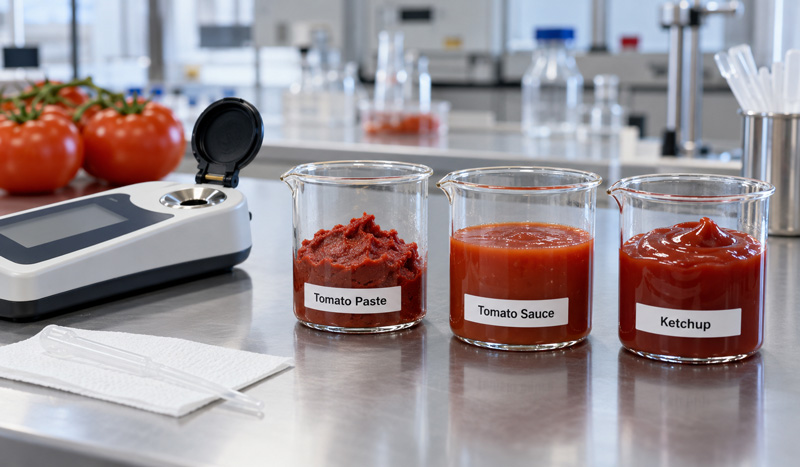
On Hongburg's side, the two specifications illustrate the point. Hongburg tomato paste is supplied in concentration grades of 12.5–22, 22–28 and 28–36°Brix, made from tomato only, with no additives; Hongburg tomato ketchup is specified at 20–24°Brix with water, tomato, sugar, salt, vinegar and flavouring on the ingredient list (product standards GB/T 14215 and SB/T 10459). Hongburg tomato sauce, a tomato-and-water product with no additive, sits at 12.5–25°Brix. A 22°Brix paste, a 22°Brix tomato sauce and a 22°Brix ketchup are three different tomato contents: the sauce figure reflects dilution with water, and the ketchup figure includes its sugar and salt. The grade a buyer needs depends on the application; the refractometer method and reporting basis are stated on the specification.
3. Thickness, colour and acidity: what to ask
Thickness. The common laboratory measure is the Bostwick test, which records how far a sample flows along a trough in a set time at a set temperature; the USDA manual describes one version of the method. The buyer's questions are simple: which method, at what temperature, and on the product as supplied or after dilution. For ketchup, the more useful check is how the product leaves the intended bottle or sachet: how it starts, whether the stream holds, how it stops, and what stays on the nozzle.
Colour. Two supplier samples can only be compared by eye under the same light, in the same container, at the same dilution; a deep paste and its diluted form look like different products. Instrument readings add a second problem: a colour-measurement specialist notes that a liquid's opacity and the thickness of the sample change how colour has to be measured. (HunterLab, technical note on measuring liquid colour) Readings from different setups do not line up, so the buyer asks for the measurement conditions alongside any colour value and records paste as supplied and paste as diluted separately.
Acidity. pH tells you how acidic a product is; titratable acidity tells you how much acid it contains. They are different tests and both may appear on a specification. The buyer asks for the method with each value. The taste question, whether the sweetness and acidity balance suits the intended use, is answered by tasting the product in that use.
Storage. For a first supplier comparison, the storage information needed is the stated shelf life, the storage conditions and the basis for both. A full storage study belongs to a later stage, typically a private label project where the buyer's pack and formula are fixed.
Hongburg's standard specification items for these two products show how the three fields are expressed in practice:
|
Field |
Tomato paste |
Tomato ketchup |
|
Consistency (Bostwick) |
2.5–6.0 cm/30 s |
6–10 cm/30 s |
|
Colour (a/b ratio) |
≥1.8 |
1.8–2.0 |
|
pH |
3.0–4.5 |
3.4–4.0 |
|
Salt (as NaCl) |
not specified (tomato only) |
2.5–3.8% |
|
Process type |
Cold-break, warm-break or hot-break; aseptic filling |
Blending, high-shear mixing, homogenization, pasteurization |
Two things to notice. The paste flows less than the ketchup on the Bostwick trough, as the lower figure shows, and the paste's wider pH range reflects a single-ingredient product whose acidity follows the fruit. Colour is expressed as the a/b ratio from CIE Lab measurement, and the specification notes that cold-break paste reads brighter red and hot-break deeper red, which is why the buyer compares colour within one break type. Titratable acidity is not a standard item on these sheets and is requested per project.
4. Three documents, three different questions
Specifications, certificates of analysis and application trials are often treated as interchangeable proof. They answer different questions.
|
Document |
The question it answers |
What must be visible |
|
Specification |
What has been agreed for supply? |
Product code, version and date, parameters with methods and tolerances, packaging |
|
Certificate of analysis (COA) |
What was measured on this batch? |
Batch code, the specification version it was tested against, methods and results |
|
Application trial |
Did this sample work in the buyer's use? |
Sample batch, dilution or recipe, equipment, conditions, observations |
A COA on its own does not tell a buyer whether a ketchup dispenses well from a given cap, and a good kitchen result does not tell the buyer that the next production batch meets the specification. The three records work together, and the link between them is the batch code.
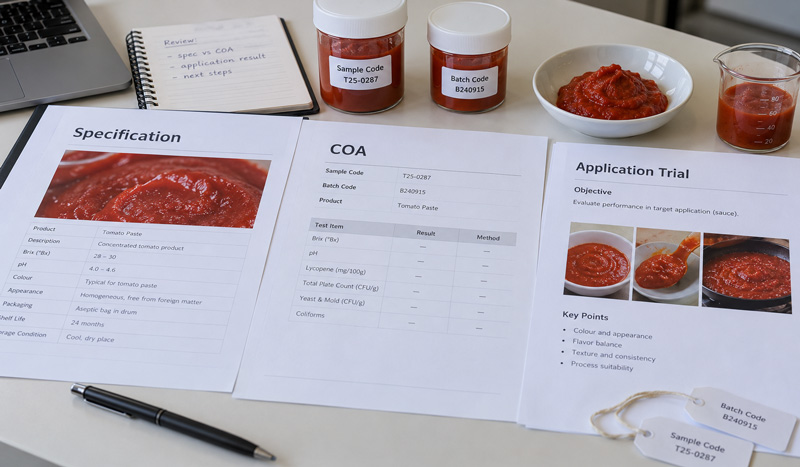
Hongburg's specifications carry a document number, version and effective date (for example tomato paste HBTOMA001) and the microbiological fields a COA reports against: total plate count ≤100 CFU/g, coliforms ≤10 CFU/g, yeast and mould ≤10 CFU/g, Salmonella absent in 25 g, and a Staphylococcus aureus criterion (sampling plan n=5, c=1, m=100 CFU/g, M=1,000 CFU/g for paste; absent in 25 g for ketchup).
5. Where inquiries usually fall short
Suppliers see the same gaps repeatedly: a Brix figure quoted without saying whether it was measured on paste or on finished sauce; a request for "tomato sauce" with no application; a pack request without a net weight. Filling those in before the first exchange saves a round of questions.
6. Safety and destination documents
Which safety tests apply depends on the product, the process, the pack and the destination, and the buyer's technical reviewer settles that list. Codex's General Principles of Food Hygiene ask for food-safety controls that are validated for the product and its intended use. The checklist below covers the documents to request; the acceptance limits come from the destination country's rules.
Hongburg holds ISO 22000, ISO 9001 and HACCP certification, FDA registration and export filing, and HALAL documentation is available at company level, with coverage of a specific product confirmed before a formal specification is issued. Shelf life on both products is 12–24 months by pack, with ambient storage before opening and refrigeration after opening.
7. The checklist
Print this section or copy it into the comparison file. Every line is a yes/no item; a "no" is a question for the supplier, not a rejection.
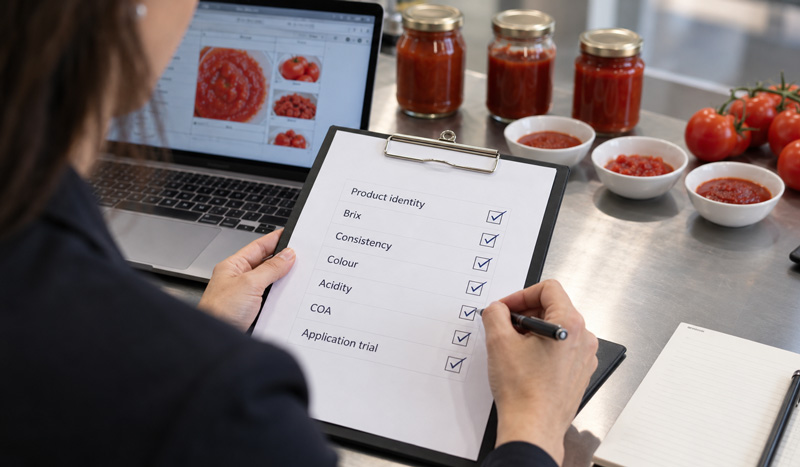
Product identity
· ☐ The buyer's product description (type, use, destination country) is written down
· ☐ The supplier's product name and code match that description
· ☐ The specification version and date are stated
Concentration
· ☐ Brix is stated with the test method and whether it was measured on paste or finished product
· ☐ Any adjusted tomato-solids figure comes with the original reading and the calculation
· ☐ Use rate at the buyer's dilution or recipe is known
Thickness
· ☐ Method (Bostwick or other), temperature and sample preparation are stated
· ☐ For ketchup: flow from the intended bottle or sachet has been observed
Colour
· ☐ Samples were compared under the same light, container and dilution
· ☐ Any instrument value comes with its measurement conditions
Acidity
· ☐ pH and titratable acidity are listed separately, each with its method
· ☐ Taste balance has been checked in the intended use
Ingredients, safety and documents
· ☐ Full ingredient list and allergen information for this product
· ☐ Stated shelf life, storage conditions and their basis
· ☐ Microbiological, contaminant and additive requirements for the destination identified by the technical reviewer
· ☐ Food-contact packaging documentation available
· ☐ Legal product name and label requirements for the destination checked
· ☐ Required certificates identified (ISO, HACCP, HALAL as applicable)
Documents and trial
· ☐ COA for the sample batch, referencing the specification version
· ☐ Application trial recorded with batch, recipe or dilution, equipment and observations
8. FAQ
Does a higher Brix mean more tomato?
Not automatically. Brix is dissolved-solids concentration and, in a finished sauce, includes sugar and salt. Compare it together with the use rate and the finished-product result.
Can two suppliers' Brix figures be compared directly?
Only within the same product type, the same method and the same reporting basis. A paste Brix and a ketchup Brix do not go in the same column.
Why is tomato paste thickness not given in mPa·s?
Tomato products are more often described by Bostwick consistency, because it reflects flow and thickness more directly than a rotational viscosity figure. Method and temperature must match for a cross-supplier comparison.
Can a COA replace the specification?
No. The COA is evidence for one batch against one specification version; the specification is the agreed product itself. Keep the two together.
9. Sending a comparison to Hongburg
An importer can send a current specification, a competing quotation or the two figures that will not reconcile through the Hongburg inquiry page, together with the destination country, the application and the pack in mind. The reply can then focus on the proposed product's specification, sample options and the documents that apply to it. See our tomato paste, tomato sauce, tomato ketchup and tomato-based sauces pages.
Samples are free; freight is paid by the customer.
Send us your specification comparison → https://hongburg.com/message.html
Send Inquiry
