
- English
- Español
- Português
- русский
- Français
- 日本語
- Deutsch
- tiếng Việt
- Italiano
- Nederlands
- ภาษาไทย
- Polski
- 한국어
- Svenska
- magyar
- Malay
- বাংলা ভাষার
- Dansk
- Suomi
- हिन्दी
- Pilipino
- Türkçe
- Gaeilge
- العربية
- Indonesia
- Norsk
- تمل
- český
- ελληνικά
- український
- Javanese
- فارسی
- தமிழ்
- తెలుగు
- नेपाली
- Burmese
- български
- ລາວ
- Latine
- Қазақша
- Euskal
- Azərbaycan
- Slovenský jazyk
- Македонски
- Lietuvos
- Eesti Keel
- Română
- Slovenski
- मराठी
- Srpski језик

How Can Importers Avoid Buying the Wrong Tomato and Mayonnaise Products?
How Can Importers Avoid Buying the Wrong Tomato and Mayonnaise Products?
Two products can both be described as “tomato sauce” and still be completely different in concentration, seasoning, packaging and end use. Mayonnaise creates a different kind of sourcing problem: two products can look almost identical in a specification sheet but behave differently when spread, mixed into a salad or used in a foodservice kitchen.
For importers, the problem is not simply understanding product names. The real challenge is making sure that the product definition matches the intended application.
That matters because tomato paste, tomato sauce, tomato ketchup and mayonnaise do not follow the same purchasing logic. A mismatch at the definition stage can lead to the wrong sample, the wrong packaging format, an unsuitable formula or a price comparison that is not actually comparing equivalent products.
1. Start With Product Function, Not Only the Product Name
Product names are useful, but they are not always precise enough for international sourcing.
The term “tomato sauce” is a good example. Depending on the market, it may refer to a relatively simple cooking sauce, a seasoned ready-to-use product or even something closer to ketchup. A supplier and an importer can therefore use the same term while imagining different products.
The safer approach is to define the function first.
An importer should ask:
- Will the product be used directly or cooked further?
- Is it for retail, foodservice or food manufacturing?
- Is the buyer expecting a concentrated ingredient or a finished condiment?
- Does the product need to be squeezed, spread, diluted, mixed or heated?
- Is the project standard supply or private label development?
These questions quickly narrow the category.
A concentrated product for cooking belongs to a different sourcing conversation from a finished condiment in a squeeze bottle. A mayonnaise intended for sandwich production should not be evaluated in exactly the same way as a retail mayonnaise sold in a jar.
2. Tomato Paste: Concentration and Processing Use Come First
Tomato paste is normally the easiest category to define because concentration is central to the product.
It is made by concentrating processed tomatoes and removing part of their water content. The result is a thick product with a higher level of tomato solids than ordinary tomato sauce or ketchup.
For importers, tomato paste is often closer to an ingredient than a table condiment.
Typical applications include:
- cooking bases;
- soups and stews;
- pizza and pasta sauce production;
- food manufacturing;
- catering kitchens;
- further sauce processing.
The main sourcing discussion therefore tends to involve Brix, color, viscosity, acidity, consistency and packaging.
A common mistake is to compare tomato paste only by price per carton or price per ton. If two offers have different concentrations, pack formats or processing characteristics, the cheaper quotation may not represent the same product.
The buyer should first confirm what the paste will be used for and what concentration is needed.
3. Tomato Sauce: The Category Most Likely to Cause Confusion
Tomato sauce has a much wider definition.
Unlike tomato paste, it is usually less concentrated and may already contain seasonings or other ingredients. But the exact formula and intended use can vary considerably.
A buyer asking for tomato sauce could mean:
- a simple tomato cooking sauce;
- a seasoned sauce for home cooking;
- a pizza base;
- a pasta sauce;
- a foodservice cooking sauce;
- a ready-to-use retail product.
This is where incorrect sourcing often begins.
A supplier may quote a basic tomato sauce when the importer actually wants a seasoned pasta-style product. Another supplier may understand “tomato sauce” as a product with a flavor profile closer to ketchup.
For importers, the solution is straightforward: define the application before discussing the final specification.
If the product will be used on pizza, spreadability and baking behavior matter. If it is intended for pasta, seasoning balance and ready-to-use texture may be more important. If it is for a food manufacturer, batch consistency and compatibility with the final recipe may become the priority.
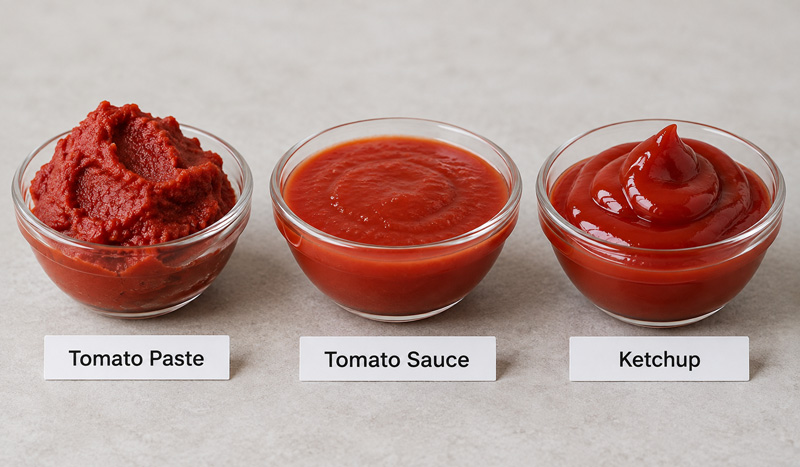
4. Tomato Ketchup: A Finished Condiment, Not a Concentrated Tomato Ingredient
Tomato ketchup is easier to recognize from the consumer side, but importers still need to distinguish it clearly from tomato sauce.
Ketchup is normally a finished condiment designed for direct use. Its formula typically aims for a specific balance of tomato flavor, sweetness, acidity, texture and seasoning.
The purchasing focus is therefore different.
An importer may need to evaluate:
- finished taste;
- sweetness and acidity balance;
- color;
- viscosity;
- squeeze performance;
- bottle or pouch format;
- portion size;
- retail or foodservice positioning.
The mistake is treating ketchup as simply “another tomato product.”
Tomato paste is commonly selected for concentration and further use. Tomato sauce may be selected for cooking. Ketchup is selected as a finished condiment.
That distinction changes both specification and packaging.
A ketchup that works well in a retail squeeze bottle may not be the right choice for sachet filling or high-volume foodservice use. The formula and dispensing behavior need to match the channel.
5. Mayonnaise Is a Different Product System Entirely
Mayonnaise often appears next to ketchup on a retail shelf or fast-food table, but technically it belongs to a different product system.
It is an emulsified sauce, typically built around oil, a water phase, acid and emulsifying or stabilizing components depending on the formula.
This changes what buyers need to evaluate.
With mayonnaise, important questions include:
- oil level;
- texture;
- mouthfeel;
- emulsion stability;
- spreadability;
- coating performance;
- flavor profile;
- behavior during storage and use.
A mayonnaise can look smooth in a sample jar but still be unsuitable for the buyer’s real application.
For example, a very thick mayonnaise may look premium but be difficult to dispense from a squeeze bottle. A thinner product may work well in some salad applications but not provide enough body for a burger or sandwich.
The correct viscosity is therefore application-dependent.
Importers should not compare mayonnaise only by appearance, oil percentage or price. The buyer should test how the product performs in the intended channel.
6. Where Importers Most Commonly Mix Up These Categories
The most frequent sourcing errors usually happen at category boundaries rather than within a clearly defined product.
| Common Confusion | Why It Happens | What Importers Should Confirm |
|---|---|---|
| Tomato paste vs tomato sauce | Both are tomato-based and used in cooking | Concentration, Brix, seasoning and intended use |
| Tomato sauce vs ketchup | Market terminology varies | Whether the product is for cooking or direct condiment use |
| Ketchup vs tomato-based dipping sauce | Similar appearance and use | Formula, seasoning, viscosity and target channel |
| Mayonnaise vs salad dressing | Both can be creamy and emulsified | Oil level, acidity, sweetness, application and texture |
| Retail mayonnaise vs foodservice mayonnaise | Product name may be identical | Pack format, viscosity, turnover and dispensing requirements |
These distinctions sound simple once they are written down. In actual purchasing conversations, they are easy to overlook when the discussion starts with a product name and price rather than an application.
7. Mayonnaise and Salad Dressing Can Also Be Misclassified
Another common confusion is between mayonnaise and creamy salad dressing.
They may look similar, but the formulation and intended use can be different.
Mayonnaise is generally expected to provide a richer, denser emulsified texture. Creamy dressings may be lighter, more acidic, sweeter or designed specifically to coat vegetables and salads.
The exact legal or labeling definition can also vary by market, so importers should not rely only on appearance.
For a sourcing project, buyers should confirm:
- intended application;
- oil level;
- sweetness and acidity;
- texture target;
- label naming requirements;
- retail or foodservice format.
A buyer who expects mayonnaise but receives a lighter dressing-style product may reject the sample even though both products look similar in a photograph.
That is why product definition should be agreed before sampling.
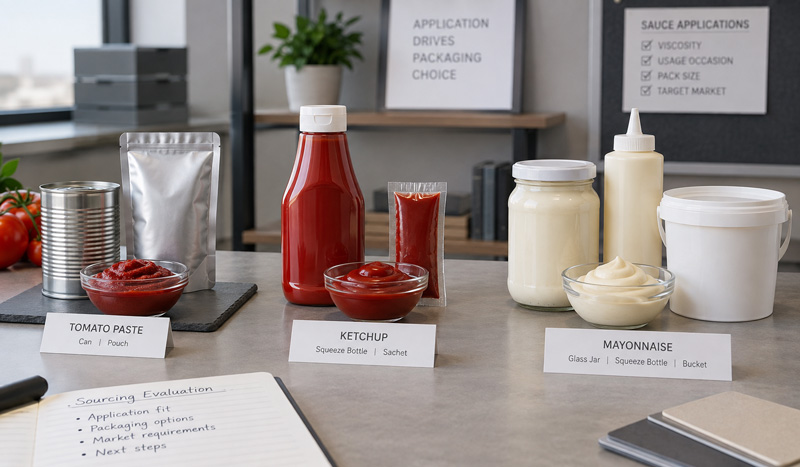
8. Packaging Can Reveal Whether the Product Definition Is Correct
Packaging often exposes a mismatch between product and application.
If a buyer requests tomato paste in a squeeze bottle, the supplier should confirm whether the buyer truly means concentrated tomato paste or is actually looking for tomato sauce or ketchup.
If a customer requests retail mayonnaise in a large bucket, the real target may be foodservice rather than supermarket resale.
Typical packaging logic is different across categories:
- tomato paste commonly uses cans, pouches or aseptic cartons;
- tomato sauce may use jars, cans, cartons or pouches depending on application;
- ketchup often uses squeeze bottles, sachets and foodservice pouches;
- mayonnaise commonly uses jars, squeeze bottles, pouches and buckets.
Packaging does not define the product by itself, but it is a useful cross-check.
If the product name, application and packaging do not fit together, the importer should clarify the project before confirming the order.
9. A Better Way to Send a Sourcing Inquiry
Instead of sending:
Please quote tomato sauce.
A more useful inquiry would be:
We are looking for a tomato-based cooking sauce for retail sale. The product will be used mainly for pasta and home cooking. We prefer a ready-to-use formula and a consumer-size package.
Instead of:
Please quote mayonnaise.
The buyer can say:
We need mayonnaise for foodservice sandwich and burger applications. We require good spreadability, stable texture and packaging suitable for restaurant kitchens.
This small change can save several rounds of sample development.
The supplier can immediately understand the buyer’s intended use, and the importer is more likely to receive a relevant specification and quotation.
10. How Hongburg Supports Clearer Product Matching
Hongburg Flavormaker works with global importers, distributors, foodservice buyers and private label buyers across tomato-based products, ketchup, mayonnaise and other sauce categories.
The first step in a sourcing project should not be choosing a pack design or simply asking for the lowest price. It should be confirming what the product is expected to do.
For tomato-based products, that may mean clarifying concentration, cooking application, seasoning and packaging. For mayonnaise, the discussion may focus more on texture, oil level, emulsion stability, application performance and channel requirements.
This becomes especially important for a private label sauce project, where product definition affects formula development, packaging selection and final label positioning.
For buyers comparing a long-term sauce supplier, clear product definitions also make quotations easier to compare because the suppliers are working from the same commercial brief.
Conclusion
Most sourcing mistakes between tomato products and mayonnaise do not begin with manufacturing. They begin earlier, when the product definition is too broad.
Tomato paste is a concentrated ingredient-type product. Tomato sauce covers a wider range of cooking applications. Tomato ketchup is a finished condiment. Mayonnaise is an emulsified sauce with its own texture and stability requirements.
For importers, the safest approach is to define application, channel and packaging before comparing prices.
When the product role is clear, supplier communication becomes faster, samples become more relevant and the risk of buying the wrong product is much lower.
FAQ
1. Is tomato paste the same as tomato sauce?
No. Tomato paste is more concentrated and is commonly used as an ingredient or cooking base. Tomato sauce is usually less concentrated and may already contain seasoning or be designed for a more specific cooking application.
2. What is the main difference between tomato sauce and ketchup?
Tomato sauce is commonly associated with cooking, while ketchup is normally a finished condiment for direct use. Market terminology can vary, so the intended application should always be confirmed.
3. Can ketchup be used as tomato sauce?
It can be used in some recipes, but the products are not equivalent from a sourcing perspective. Ketchup normally contains a finished sweet-acid flavor profile that may not suit applications designed for tomato sauce.
4. Why does mayonnaise need separate sourcing criteria?
Mayonnaise is an emulsified product, so texture, oil level, emulsion stability, mouthfeel and application performance become important sourcing factors.
5. Is creamy salad dressing the same as mayonnaise?
Not necessarily. Creamy dressings may have different oil levels, acidity, sweetness, texture and intended use. Buyers should confirm the formula and local labeling requirements.
6. What information should an importer provide before requesting a sample?
The buyer should ideally specify the product application, sales channel, target texture or concentration, packaging format, private label requirements and any important market or labeling needs.
Send Inquiry
