- English
- Español
- Português
- русский
- Français
- 日本語
- Deutsch
- tiếng Việt
- Italiano
- Nederlands
- ภาษาไทย
- Polski
- 한국어
- Svenska
- magyar
- Malay
- বাংলা ভাষার
- Dansk
- Suomi
- हिन्दी
- Pilipino
- Türkçe
- Gaeilge
- العربية
- Indonesia
- Norsk
- تمل
- český
- ελληνικά
- український
- Javanese
- فارسی
- தமிழ்
- తెలుగు
- नेपाली
- Burmese
- български
- ລາວ
- Latine
- Қазақша
- Euskal
- Azərbaycan
- Slovenský jazyk
- Македонски
- Lietuvos
- Eesti Keel
- Română
- Slovenski
- मराठी
- Srpski језик


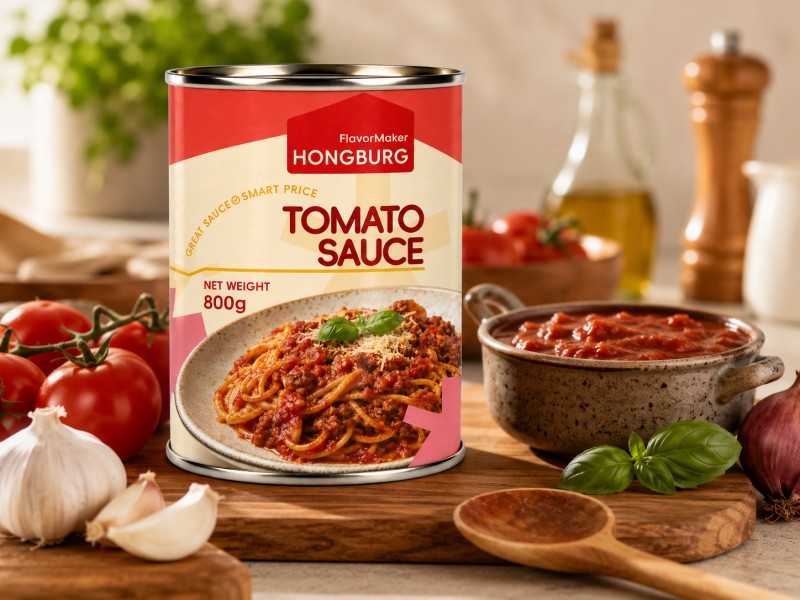
Canned Tomato Sauce
Bulk catering in Africa and the Middle East demands resilience. Wholesale Canned Tomato Sauce by Hongburg solves thermal degradation. This heavy-duty tinplate format protects the rich Brix profile from shipping shocks, ensuring high-yield culinary performance for global kitchens.
Send Inquiry
Product Description
Deploying large volumes of tomato-based condiments across arid or tropical climates presents unique, high-stakes logistical hurdles. Commercial kitchens and institutional catering syndicates in regions like the Middle East, Africa, and South America frequently face ambient warehouse environments that far exceed optimal storage temperatures, often exacerbated by unpredictable port customs delays. Traditional thin-walled plastic pails or lower-grade packaging often struggle under these sustained thermal conditions. They can exhibit micro-oxygen transmission and structural softening, which ultimately leads to tomato lycopene browning, unpredictable Brix (soluble solids) fluctuations, and catastrophic container collapse during high-tier pallet stacking in shipping containers.
The Hongburg Engineering Solution
To systematically mitigate these severe cross-border supply chain risks, Hongburg manufactures a heavy-duty canned configuration operating completely independently of continuous cold chains, maximizing yield and safety for bulk buyers.
1.BPA-NI Internal Coating: Because concentrated tomato pulp is naturally acidic, direct contact with bare metal can cause corrosion and metallic off-flavors. We utilize an advanced Bisphenol-A Non-Intent (BPA-NI) food-grade lacquer applied to the interior, acting as a robust chemical shield to preserve the original savory profile.
2.Absolute Structural Integrity: Encased in commercial-grade tinplate cylinders, this format is engineered to provide absolute vertical crush resistance. It enables importers to maximize 20ft container payload efficiency by stacking pallets to the ceiling without risking bottom-tier rupture.
3.Thermal Lycopene Defense: The hermetic double-seam seal acts as a zero-transmission light and gas barrier. It is designed to assist the tomato pulp in maintaining its vibrant, natural red hue and volatile savory notes, even after prolonged exposure to the intense heat of maritime transit.
4.Bostwick Viscosity Mapping & Yield Economics: Unlike retail sauces, our commercial formula is mapped using precise Bostwick consistometers. By maintaining a high, stable Brix concentration, commercial kitchens receive less water and more actual tomato solids per can. This ensures the fluid dynamics meet the demanding coating requirements of high-volume pizza crusts and pasta bases without weeping water (syneresis), directly improving the portion yield per tin.
Industrial Specification Parameters
| Analytical Target | Calibrated Measurement Range | Factory Control Instrument |
| Brix Concentration | 22% - 28% (Commercial Heavy Limits) | Digital Benchtop Refractometer |
| Bostwick Flow Rate | Optimized for Culinary Spreadability | Stainless Steel Consistometer |
| Heavy Metal Migration | Strictly Compliant with Export Codes | ICP-MS Spectrum Profiling |
| Lycopene Stability | Accelerated Thermal Shelf-Life Index | UV-Vis Spectrophotometer |
| pH Acid Balance | Strictly monitored within safe zones | In-Line Probe Calibration |
Intelligent Manufacturing & Global Market Access
Consistent product physicals at a massive industrial scale require advanced infrastructure. This formulation is produced within an expansive 22,000 square-meter intelligent manufacturing facility built to strict Industry 4.0 automation standards. This immense operational bandwidth allows global volume buyers to secure steady pricing, hedging against raw agricultural tomato seasonal fluctuations. Furthermore, we recognize that penetrating emerging markets requires precise regulatory alignment. Our compliance division operates under rigorous ISO, HACCP, and Halal frameworks, and is fully equipped to generate specialized technical dossiers. Whether you require Halal verification for the Middle East or rigorous BPOM compliance testing for Southeast Asian integrations, our facility ensures seamless international border clearance.
Hot Tags: Canned Tomato Sauce
Related Category
Send Inquiry
Please Feel free to give your inquiry in the form below. We will reply you in 24 hours.