
- English
- Español
- Português
- русский
- Français
- 日本語
- Deutsch
- tiếng Việt
- Italiano
- Nederlands
- ภาษาไทย
- Polski
- 한국어
- Svenska
- magyar
- Malay
- বাংলা ভাষার
- Dansk
- Suomi
- हिन्दी
- Pilipino
- Türkçe
- Gaeilge
- العربية
- Indonesia
- Norsk
- تمل
- český
- ελληνικά
- український
- Javanese
- فارسی
- தமிழ்
- తెలుగు
- नेपाली
- Burmese
- български
- ລາວ
- Latine
- Қазақша
- Euskal
- Azərbaycan
- Slovenský jazyk
- Македонски
- Lietuvos
- Eesti Keel
- Română
- Slovenski
- मराठी
- Srpski језик

How to Choose a Reliable Sauce Supplier for Food Importers
https://www.hongburg.com/mayonnaiseIntroduction
Choosing the right sauce supplier is an important decision for food importers who want to build a stable product portfolio and maintain long-term market development.
A reliable supplier is not only a manufacturer that provides products. For importers, the right partner should offer consistent quality, flexible packaging solutions, export support and the ability to adapt products according to different market requirements.
When sourcing sauces internationally, buyers should evaluate suppliers from several key perspectives before placing orders.
1. Evaluate the Supplier’s Manufacturing Capability
The first step when selecting a sauce supplier is understanding the manufacturer’s production capability.
Importers should consider:
What product categories can the supplier produce?
Does the supplier support OEM and private label projects?
Can the supplier provide different packaging formats?
Does the manufacturer have experience serving international markets?
A professional sauce manufacturer should have capabilities covering:
Product development
Mixing and emulsification
Homogenization
Filling
Sterilization
Packaging
Quality inspection
For importers, a supplier with broader manufacturing capability can provide more efficient sourcing solutions across different sauce categories.
Hongburg Flavormaker specializes in sauces, condiments and selected canned food products, providing OEM manufacturing, private label production and customized sauce solutions for global buyers.
2. Check Quality Management Systems
Quality consistency is one of the most important concerns for food importers.
Before selecting a supplier, buyers should review:
Food safety management systems
Raw material control procedures
Production monitoring
Finished product inspection
Documentation management
For sauce products, buyers should also consider product performance factors such as:
Flavor consistency
Texture stability
Viscosity
Color
Shelf stability
A reliable supplier should have a clear quality management process to help ensure product consistency between different production batches.
Hongburg applies quality management systems including ISO22000, ISO9001, HACCP, HALAL and FDA Registration.
3. Consider Product Range and Market Flexibility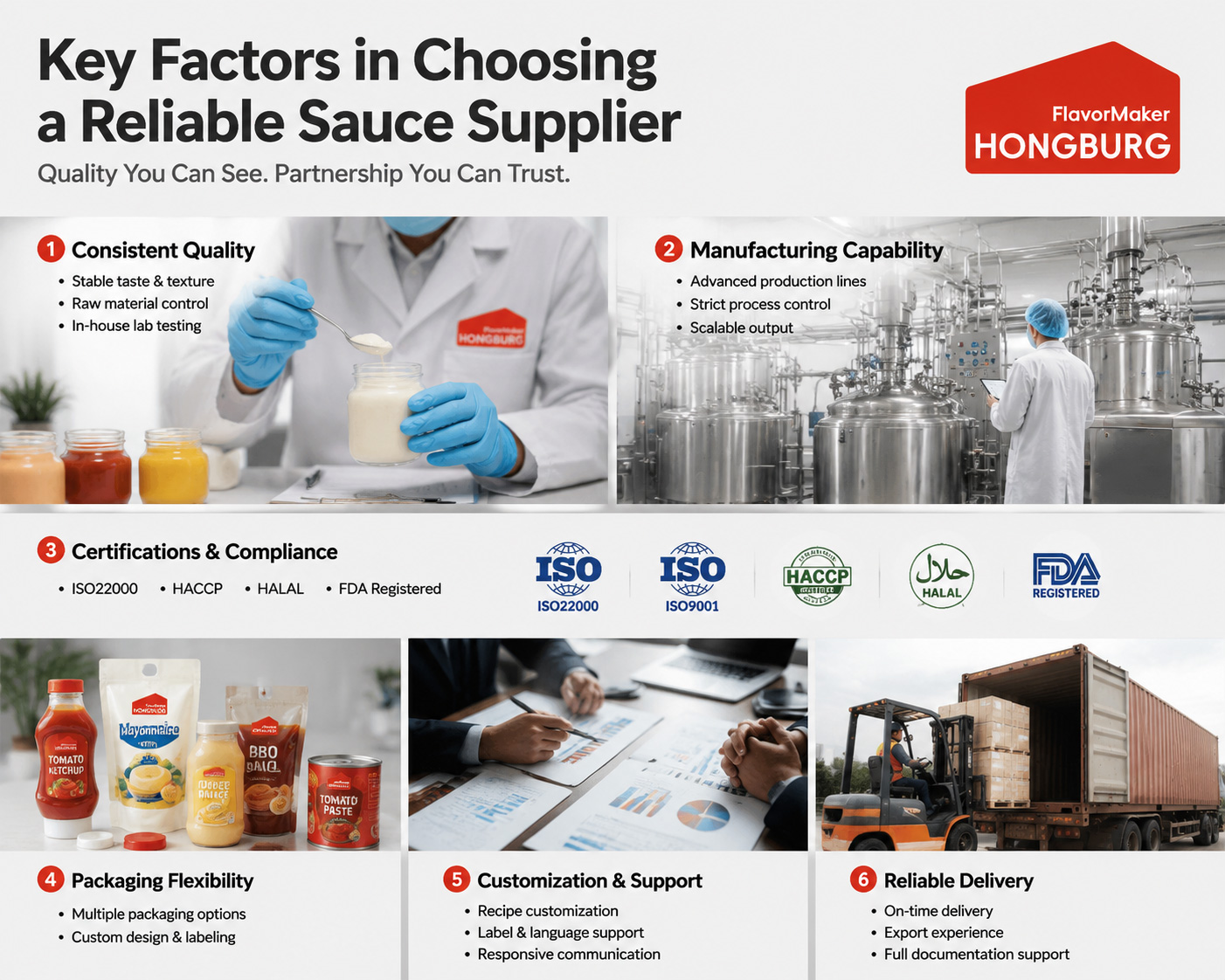
Importers often need suppliers that can support multiple product categories.
A supplier with a wider product range can help buyers:
Expand product portfolios
Reduce supplier management complexity
Develop different market channels
Common sauce categories include:
Mayonnaise
Cheese Sauce
Tomato-based Sauces
Pizza Sauce
Pasta Sauce
BBQ Sauce
Burger Sauce
Salad Dressing
Different markets may have different consumer preferences, so importers should also evaluate whether suppliers can adjust products according to local requirements.
4. Review Packaging Options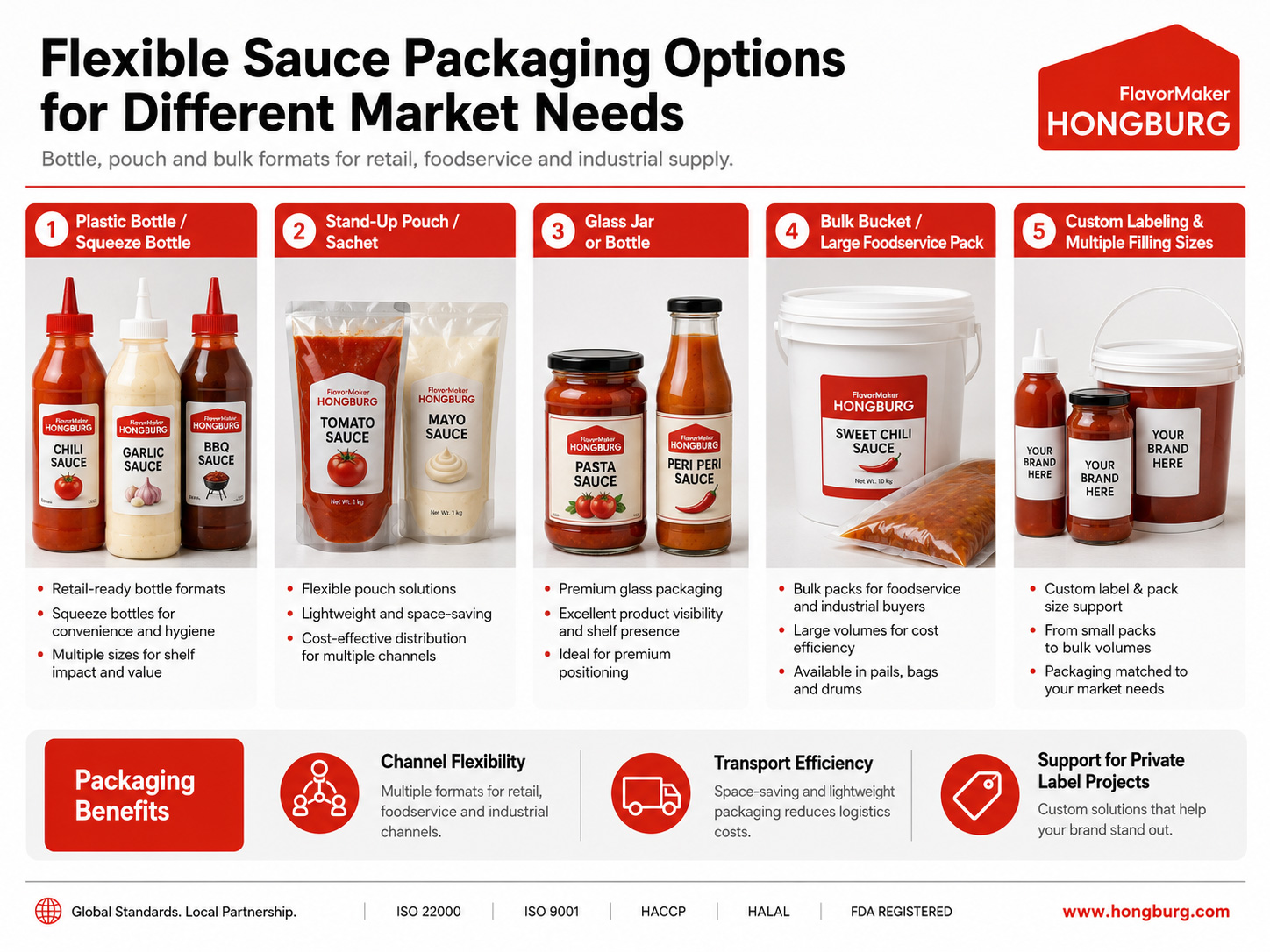
Packaging selection directly affects transportation, retail positioning and foodservice applications.
Importers should ask suppliers about available packaging formats, including:
Bottle
Glass jar
Pouch
Tetra Pak
Can
Bucket
Different buyer types may require different solutions:
Retail Buyers
Usually focus on:
Shelf-ready packaging
Label requirements
Consumer convenience
Foodservice Buyers
Usually focus on:
Bulk packaging
Easy application
Operational efficiency
A flexible sauce supplier should be able to recommend suitable packaging according to market needs.
Hongburg provides multiple packaging solutions including pouch, Tetra Pak, glass, can and plastic packaging formats.
5. Understand OEM and Customization Capability
For importers developing their own brands, customization capability is an important supplier selection factor.
A professional OEM sauce supplier should support adjustments such as:
Flavor profile
Sweetness level
Salt level
Acidity
Texture
Viscosity
Packaging and labeling support are also important for private label projects.
Before cooperation, buyers should confirm:
Product development process
Sample approval process
Formula adjustment capability
Packaging support
Flexible customization allows importers to create products that better match their target markets.
6. Confirm Export Support Capability
International sourcing requires more than product manufacturing.
Importers should evaluate whether suppliers can support:
Export documentation
Label coordination
Packaging coordination
Production scheduling
Shipment communication
Good communication and export experience help reduce risks during international purchasing.
A reliable supplier should understand the requirements of overseas buyers and provide clear information throughout the sourcing process.
7. Common Mistakes When Choosing a Sauce Supplier
Choosing Only Based on Price
The lowest quotation may not always provide the best long-term value.
Importers should evaluate:
Quality consistency
Supply reliability
Communication efficiency
Customization capability
Ignoring Packaging Requirements
Different markets have different packaging expectations.
Selecting unsuitable packaging may increase logistics challenges or limit sales channels.
Not Confirming Customization Ability
For private label projects, buyers should confirm supplier capabilities before starting development.
Supplier Evaluation Checklist for Importers
Before selecting a sauce supplier, importers can review:
|
Evaluation Area |
Questions to Ask |
|
Manufacturing |
Does the supplier have suitable production capability? |
|
Quality |
Does the supplier have food safety systems and inspection procedures? |
|
Product Range |
Can the supplier provide different sauce categories? |
|
Packaging |
Are suitable packaging options available? |
|
Customization |
Can formulas and labels be adjusted? |
|
Export Support |
Can the supplier support international shipments? |
Why Work with Hongburg Flavormaker?
Hongburg Flavormaker is an export-focused food manufacturer specializing in sauces, condiments and selected canned food products.
The company supports global buyers through:
OEM manufacturing
Private label production
Customized sauce solutions
Flexible packaging options
Export support
For importers looking for a practical sauce manufacturing partner, selecting a supplier with manufacturing capability, customization flexibility and export support can help create a more stable sourcing process.
FAQ
1. What should importers look for in a sauce supplier?
Importers should evaluate manufacturing capability, quality systems, product range, packaging options, customization ability and export support.
2. Can sauce suppliers provide private label products?
Yes. Many professional sauce manufacturers support private label projects with customized formulas, packaging and labeling solutions.
3. What packaging options are available for sauce products?
Common options include bottles, jars, pouches, Tetra Pak, cans and plastic containers.
4. How can importers check sauce quality before ordering?
Buyers can review supplier quality systems, request product samples and evaluate product consistency.
5. What is the benefit of working with an OEM sauce supplier?
OEM suppliers can help buyers develop customized products that match their target market requirements.
Contact Hongburg Flavormaker
If you are looking for a reliable sauce supplier for importing, private label or foodservice applications, Hongburg Flavormaker can provide customized manufacturing solutions based on your market requirements.
Send Inquiry
