
- English
- Español
- Português
- русский
- Français
- 日本語
- Deutsch
- tiếng Việt
- Italiano
- Nederlands
- ภาษาไทย
- Polski
- 한국어
- Svenska
- magyar
- Malay
- বাংলা ভাষার
- Dansk
- Suomi
- हिन्दी
- Pilipino
- Türkçe
- Gaeilge
- العربية
- Indonesia
- Norsk
- تمل
- český
- ελληνικά
- український
- Javanese
- فارسی
- தமிழ்
- తెలుగు
- नेपाली
- Burmese
- български
- ລາວ
- Latine
- Қазақша
- Euskal
- Azərbaycan
- Slovenský jazyk
- Македонски
- Lietuvos
- Eesti Keel
- Română
- Slovenski
- मराठी
- Srpski језик

What Are the Core Differences Between Tomato Paste, Tomato Sauce and Ketchup?
What Are the Core Differences Between Tomato Paste, Tomato Sauce and Ketchup?
Tomato paste, tomato sauce and ketchup all begin with tomatoes, but that does not make them interchangeable. The difference is not just thickness or sweetness. Each product is designed to do a different job, and that changes how an importer should compare specifications, packaging and price.
For B2B buyers, the simplest way to separate the three is to look at four things together: formula, concentration, intended use and commercial role. Once those are clear, the category boundaries become much easier to manage.
1. Tomato Paste: A Concentrated Base Rather Than a Finished Condiment
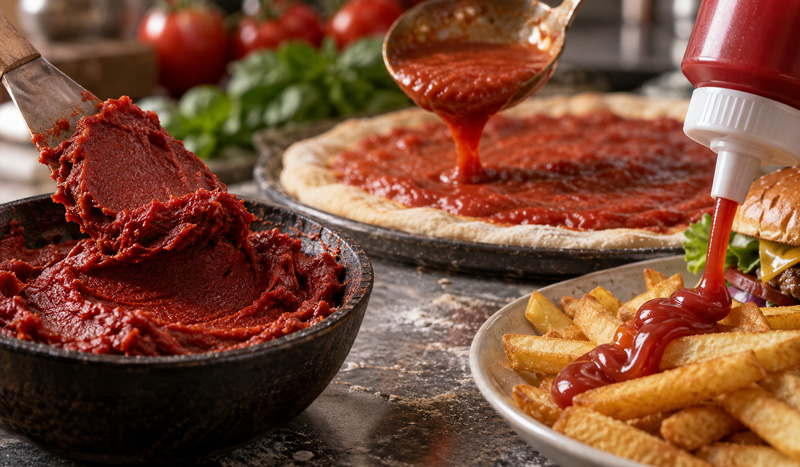
Tomato paste is the most concentrated of the three categories. It is made by processing tomatoes and removing a significant part of the water, leaving a thick product with a higher level of tomato solids.
Its role is usually closer to an ingredient than a table condiment. Importers commonly source tomato paste for cooking, blending, further processing or food manufacturing. It may become part of pizza sauce, pasta sauce, soup, stew or another tomato-based product rather than being served directly to the consumer.
That is why tomato paste discussions tend to start with technical specification. Brix, color, viscosity, acidity and pack format can matter more than finished consumer taste. A buyer using the paste in manufacturing may care about consistency and processing performance; a retail buyer may care more about can or pouch size and household cooking use.
The key point is simple: tomato paste is normally bought for what it can become after use, not for how it performs as a ready-to-eat condiment.
2. Tomato Sauce: A Wider Category Defined by Application
Tomato sauce sits in the middle. It is less concentrated than tomato paste and usually more prepared, but the category is broad enough to create confusion across markets.
One supplier may use 'tomato sauce' for a relatively simple cooking product. Another may use the same term for a seasoned sauce intended for pasta, pizza or home cooking. In some markets, the wording can even overlap with ketchup-style products.
For importers, that means the name alone is not enough. The intended application should be confirmed before specification and price are compared.
A pizza sauce buyer may need good spreadability and baking behavior. A pasta sauce buyer may care more about ready-to-use flavor, texture and seasoning. A food manufacturer may place greater weight on batch consistency and compatibility with the final recipe.
Tomato sauce is therefore best treated as an application-driven category rather than a single fixed formula.
3. Ketchup: A Finished Condiment Built for Direct Use
Ketchup is different because it is normally designed as a finished condiment. The formula aims to deliver a complete eating experience rather than serve as a base for further processing.
The buyer is therefore evaluating more than tomato content. Sweetness, acidity, seasoning, color, viscosity and dispensing behavior all contribute to the final product.
Channel also matters. A retail ketchup in a squeeze bottle needs to be easy to use and recognizable on shelf. A foodservice ketchup may be supplied in sachets, larger pouches or other formats where portion control and handling efficiency matter more than shelf presentation.
This is the commercial dividing line: tomato paste is usually a concentrated input, tomato sauce is generally a cooking-oriented category, and ketchup is a finished condiment.
4. The Formula Difference Follows the Product Role
The formulation of each product reflects what it is expected to do.
Tomato paste keeps the focus on concentrated tomato solids. Tomato sauce introduces more preparation and can include seasonings or other ingredients depending on the application. Ketchup is formulated as a finished product, with a deliberately balanced taste and texture for direct consumption.
This is why two tomato-based quotations cannot be compared only by price per carton or price per ton. If the products are built for different roles, the cost structure and specification are not equivalent.
For an importer, the correct sequence is to define the product role first, then compare formulas within the same role.
5. Concentration Does Not Create a Quality Ranking
Tomato paste is usually the most concentrated product, but higher concentration does not automatically mean higher quality for every application.
A manufacturer producing another sauce may prefer a concentrated base because it allows more control during further processing. A retail buyer looking for a ready-to-use cooking sauce needs something very different. A fast-food operator buying ketchup is concerned with direct-use performance rather than concentration alone.
Thickness can also mislead buyers. Ketchup may be visually thick, yet its thickness comes from a finished condiment formulation rather than the same concentration logic used for tomato paste.
The useful question is not 'Which product is thicker?' but 'Which product is designed for the intended use?'
6. End Use Is the Fastest Way to Separate the Three Categories
For day-to-day sourcing, end use provides a practical shortcut.
If the product will be diluted, blended or processed further, tomato paste is often the relevant category. If it is part of cooking or a prepared dish, tomato sauce may be the better fit. If it will be squeezed, dipped or served directly, ketchup is the more likely category.
This logic is especially useful when a buyer's terminology is unclear. Instead of asking only what the product is called, the supplier can ask what the buyer plans to do with it.
That single question often prevents several rounds of unsuitable samples.
7. Packaging Should Reinforce the Product Role
Packaging does not define the category by itself, but it is a useful cross-check.
Tomato paste often appears in cans, pouches or aseptic cartons because storage efficiency and further use matter. Tomato sauce may use jars, cans, cartons or pouches depending on whether it is intended for retail, foodservice or cooking applications. Ketchup is commonly linked with squeeze bottles, sachets and foodservice packs because direct dispensing is part of the user experience.
If the requested packaging and the stated product role do not fit together, the project deserves another question before samples are prepared.
For example, a request for 'tomato paste' in a consumer squeeze bottle may actually be a tomato sauce or ketchup project described with the wrong term.
8. What Importers Should Compare Before Asking Which Option Is Cheaper
Price comparison becomes useful only after the products are comparable.
For tomato paste, buyers should first align concentration, intended use and pack format. For tomato sauce, the cooking application and level of seasoning need to be clear. For ketchup, finished flavor, viscosity, dispensing behavior and sales channel should be aligned.
Only then does a price comparison show something meaningful.
Otherwise, a lower quotation may simply represent a different product rather than a better purchasing result.
9. How Hongburg Supports Tomato-Based Product Sourcing
Hongburg Flavormaker supplies tomato-based products for global B2B buyers, including tomato paste, tomato sauce, ketchup, pizza sauce and pasta sauce.
For importers, distributors and private label buyers, the useful starting point is to clarify the commercial role before moving into formula and packaging decisions. A concentrated base, a cooking sauce and a finished condiment should not be developed through the same brief.
For buyers planning a private label sauce range or comparing a long-term sauce supplier, clear category definitions make samples easier to evaluate and quotations easier to compare.
The goal is not to create more product names. It is to make sure each product has a clear job in the buyer's market.
Conclusion
Tomato paste, tomato sauce and ketchup all begin with tomatoes, but they are built for different jobs.
Tomato paste is a concentrated base ingredient. Tomato sauce is a broader cooking-sauce category that needs to be defined by application. Ketchup is a finished condiment designed for direct use.
For importers, the safest way to compare them is to define formula purpose, concentration, end use and packaging before comparing price. Once the product role is clear, sourcing becomes much more accurate.
FAQ
1. Is tomato paste the same as tomato sauce?
No. Tomato paste is usually more concentrated and is commonly used as a base ingredient, while tomato sauce is less concentrated and more dependent on the intended cooking application.
2. Is ketchup simply a sweeter tomato sauce?
Not exactly. Ketchup is a finished condiment with its own formulation, texture, flavor balance and direct-use role. Tomato sauce is usually linked more closely to cooking applications.
3. Which product is more suitable for food manufacturing?
That depends on the final product, but tomato paste is often the preferred starting point when a concentrated tomato base is needed for further processing.
4. Why is tomato sauce harder to define than tomato paste?
Because the term tomato sauce is used differently across markets and can cover several cooking and prepared-sauce styles.
5. What should importers confirm before comparing quotations?
They should first align product category, intended use, formulation direction and packaging format. Price comparison is meaningful only after those points are clear.
Send Inquiry
